How Should Buyers Compare Throughput and Footprint?
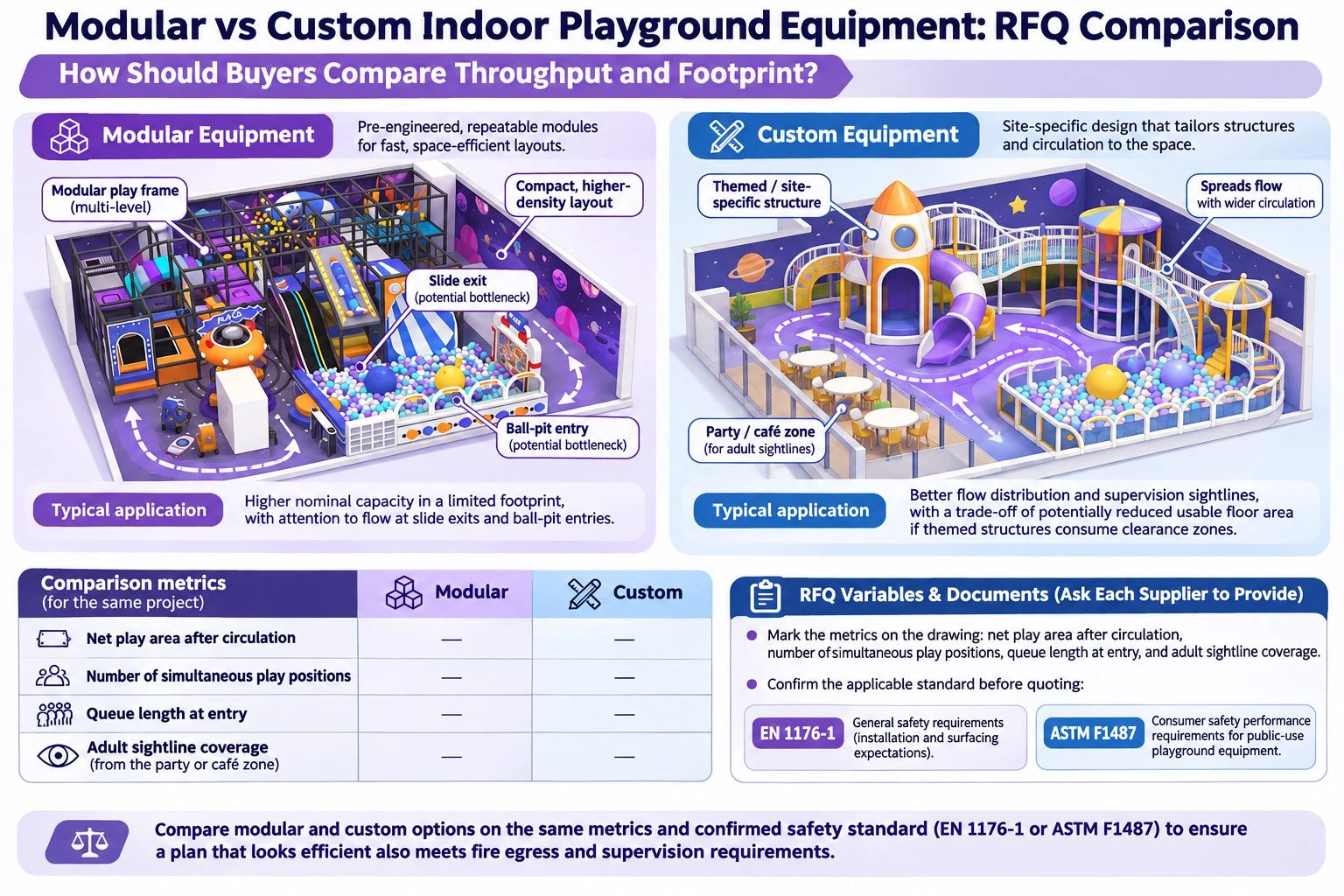
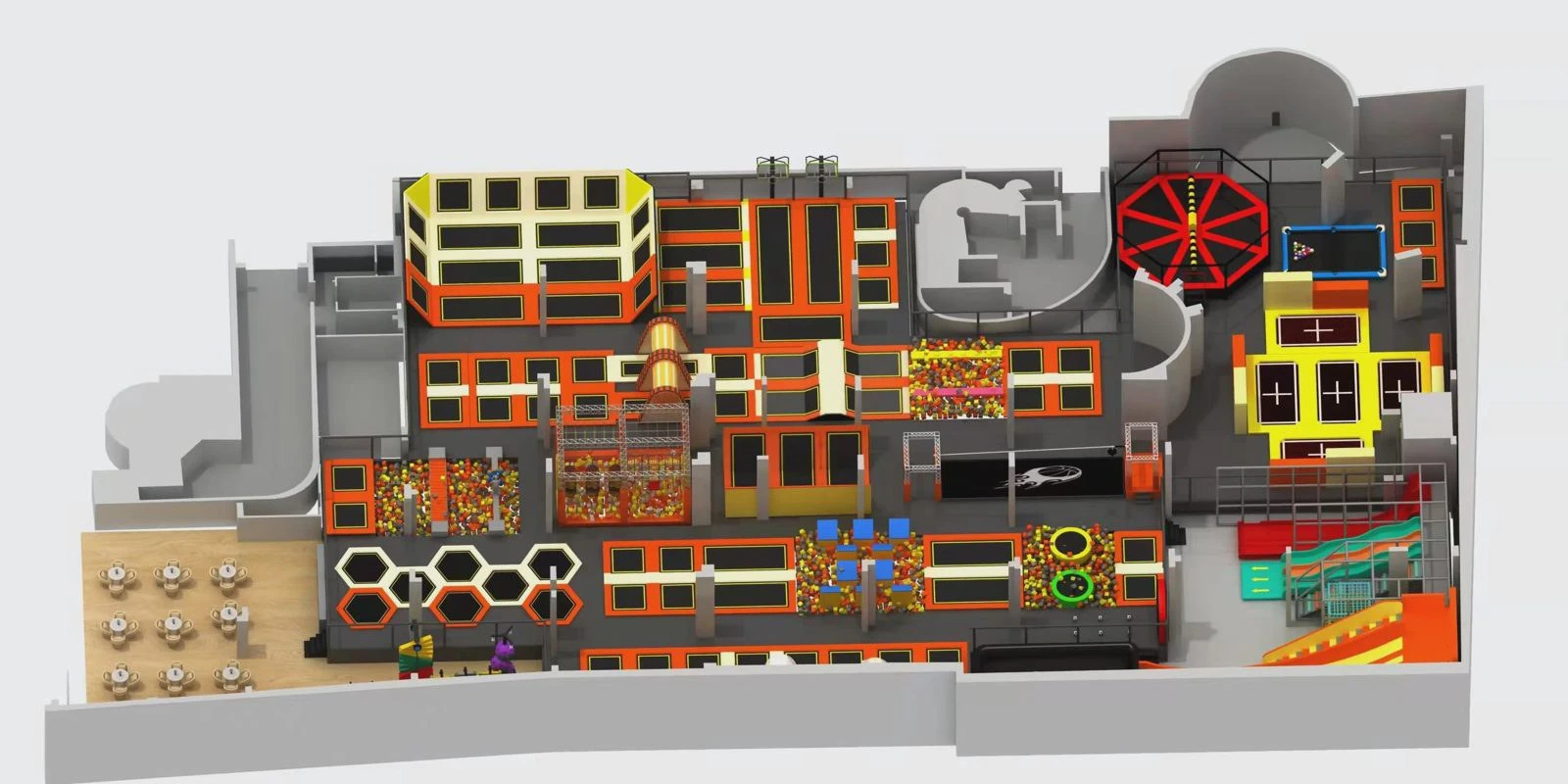
Throughput in indoor play is governed by circulation and supervision sightlines, not by the number of modules alone. A dense modular layout can raise nominal capacity but create bottlenecks at slide exits and ball-pit entries. A custom layout can spread flow, yet it may reduce usable floor area if themed structures consume clearance zones.
Compare both options on the same metrics: net play area after circulation, number of simultaneous play positions, queue length at entry, and adult sightline coverage from the party or café zone. Ask each supplier to mark these on the drawing, because a plan that looks efficient in a rendering can fail a fire egress or supervision check.
Give both bidders a copy of the same room drawing. Ask them to mark the clearance they have allowed around each activity and to identify the document, edition and equipment type behind that allowance. If a bidder cites a European standard, compare its reference with the DIN Media standard listing supplied with the brief. If the bidder cites a public playground specification, read the ASTM scope page and ask how the proposed equipment fits that scope. Record unresolved differences beside the model number and have the project reviewer check them before accepting a layout.
What Belongs in an RFQ for Each Configuration?
Give each bidder a dated copy of the same plan and equipment schedule. Ask each to price against that revision. Add a column for the item identifier and one for the boundary of the quoted work. If the custom option needs a revised opening or access panel, ask who designs it, who supplies it and where its cost appears. Keep both quotations attached to the drawing used to prepare them.
Send the following with every RFQ, whether modular or custom:
- Scaled floor plan with columns, ceiling height, door widths and egress routes.
- Target age bands and expected peak occupancy, stated as a design assumption.
- Required standards and any local inspection regime.
- Surfacing type and depth allowance, plus impact attenuation expectations.
- Power, HVAC and lighting constraints.
- Install window, site access limits and unloading conditions.
- Spares and wear-part list expectations for the first 24 months.
For custom configurations, add a design-intent package: theme references, color standards, and the acceptance criteria for finishes. For modular, add the module catalog and confirm which items are stock versus made-to-order.
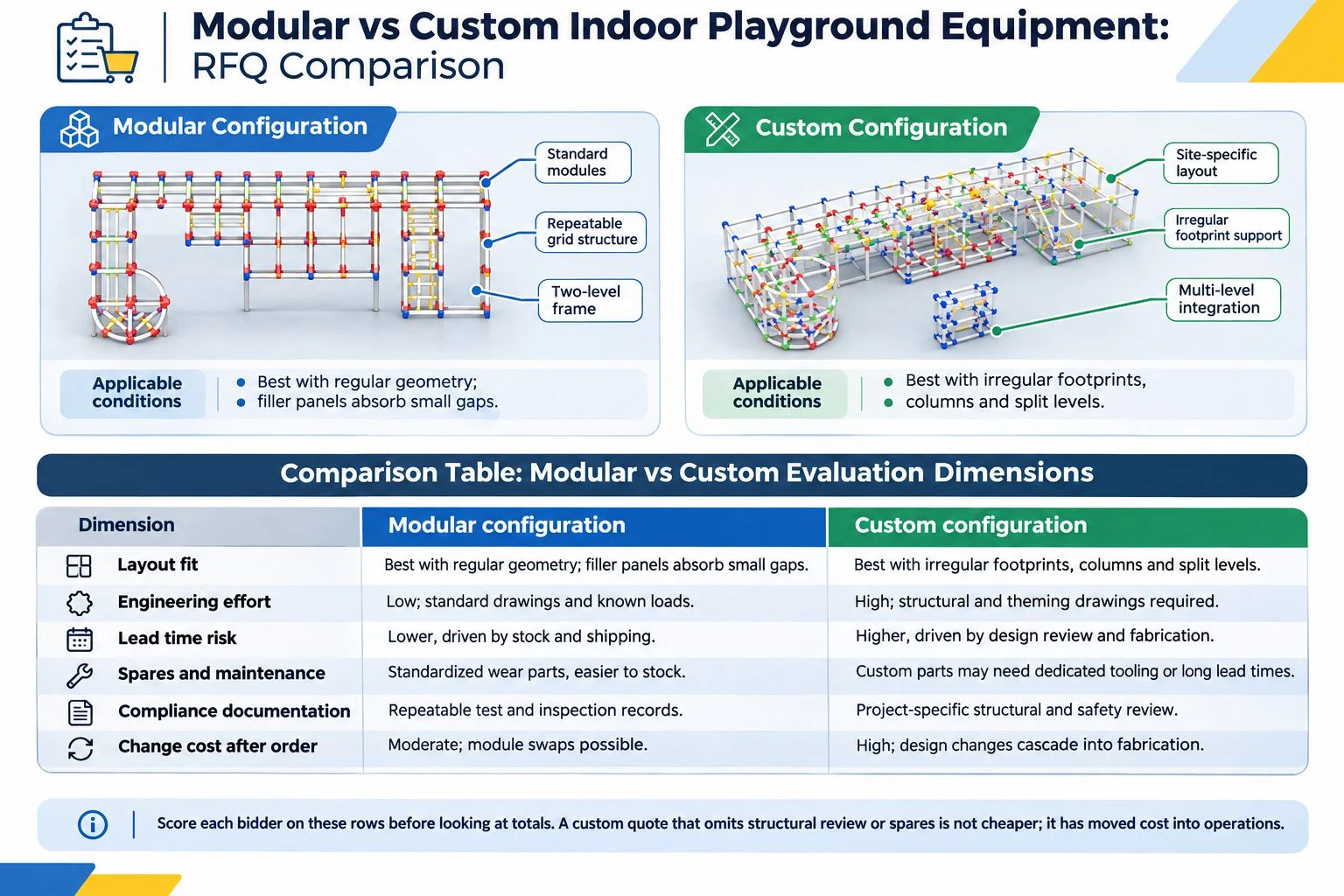
Comparison Table: Modular vs Custom Evaluation Dimensions
The table below is a decision aid, not a price list. Treat each row as a question to put to every bidder.
| Dimension | Modular configuration | Custom configuration |
|---|---|---|
| Layout fit | Best with regular geometry; filler panels absorb small gaps | Best with irregular footprints, columns and split levels |
| Engineering effort | Low; standard drawings and known loads | High; structural and theming drawings required |
| Lead time risk | Lower, driven by stock and shipping | Higher, driven by design review and fabrication |
| Spares and maintenance | Standardized wear parts, easier to stock | Custom parts may need dedicated tooling or long lead times |
| Compliance documentation | Repeatable test and inspection records | Project-specific structural and safety review |
| Change cost after order | Moderate; module swaps possible | High; design changes cascade into fabrication |
Score each bidder on these rows before looking at totals. A custom quote that omits structural review or spares is not cheaper; it has moved cost into operations.
How Do Lifecycle and Maintenance Trade-Offs Differ?
Modular systems usually win on maintenance predictability. Standard fasteners, panels and soft components can be swapped without new drawings, and a facilities team can hold a defined spares kit. Custom systems can match that discipline, but only if the supplier delivers an as-built parts schedule and identifies long-lead components.
Ask for a wear-part matrix covering soft play, netting, slides, padding and fixings, with inspection intervals. Tie acceptance to documented checks rather than verbal assurances. The CPSC public playground equipment page is a useful reference for voluntary standard updates that can affect inspection routines. Review the CPSC public playground equipment guidance and the NRPA CPSI standards resources when setting inspection scope.
Accessibility and inclusion also belong in the lifecycle plan. PlayCore's inclusion resources discuss inclusive play space design, which is relevant when custom theming risks isolating play zones. See PlayCore inclusion resources for design language you can put into the brief.
What Should Buyers Send Before Requesting a Quotation?
Include the scaled plan, dated site photographs and the ceiling and column measurements in the pre-quote pack. Mark anything that still needs a site measurement. If the lease has yet to be signed, list which building assumptions the project team needs to verify before committing to the layout. Request a written response against each open item.
For modular inquiries, reference the commercial indoor playground equipment range and ask which modules are standard stock. For custom work, use the custom playground solutions and turnkey planning page to align design stages with your schedule.
Compare replies on scope, not totals. Require each bidder to state exclusions, drawing deliverables, inspection documents and spares. The first-time buyer planning guide is a reasonable checklist for what a complete turnkey proposal should contain.
FAQ
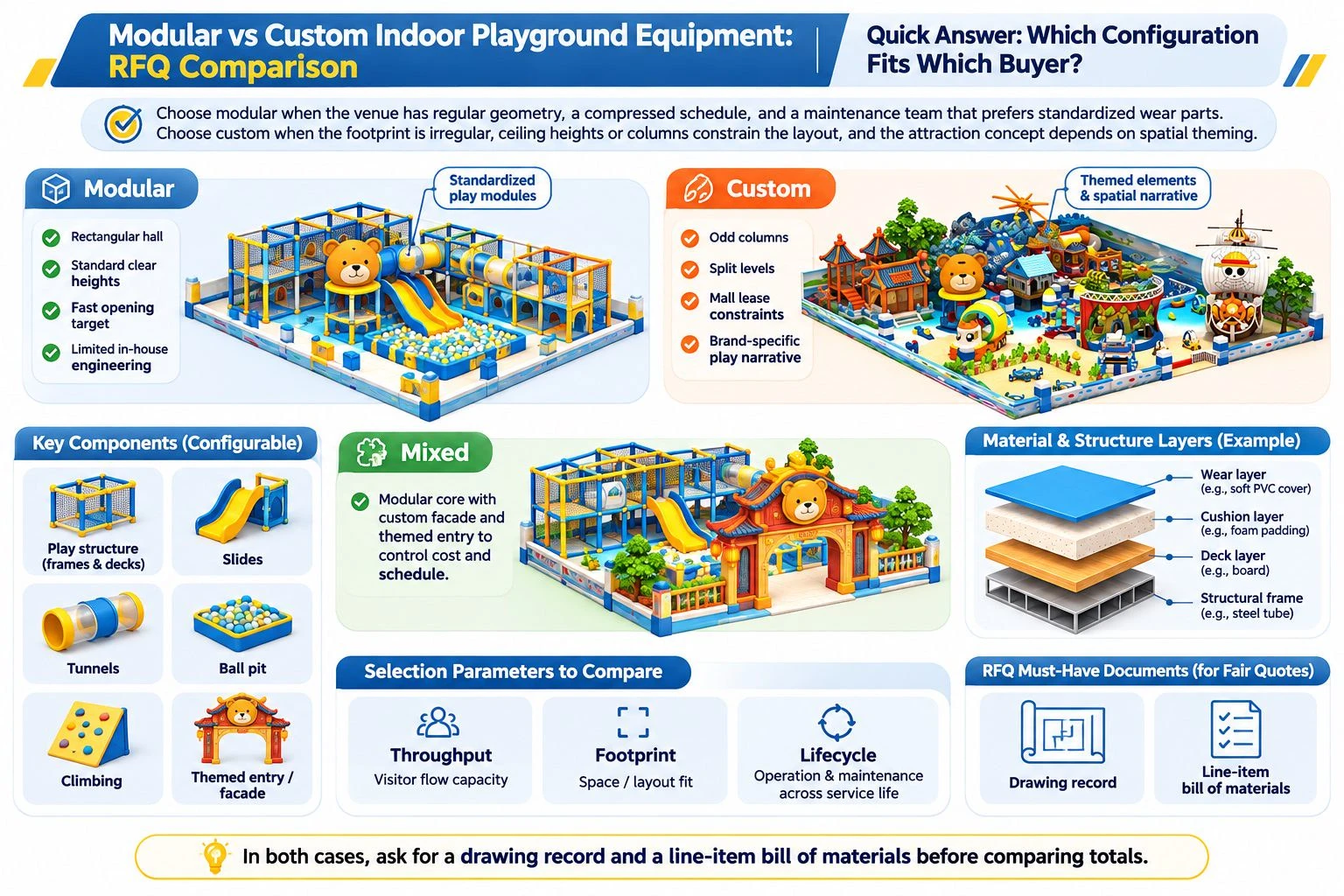
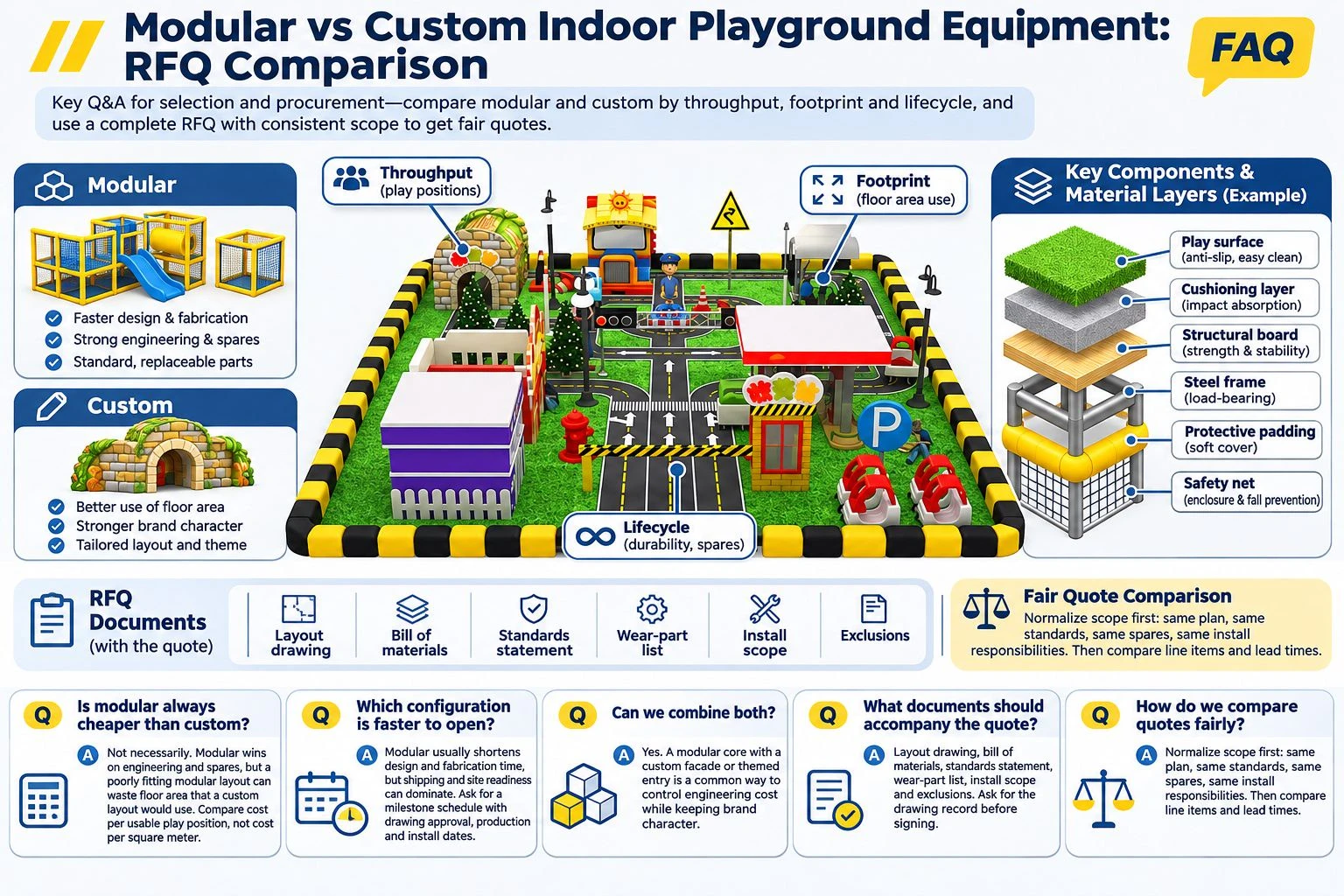
Is modular always cheaper than custom? Not necessarily. Modular wins on engineering and spares, but a poorly fitting modular layout can waste floor area that a custom layout would use. Compare cost per usable play position, not cost per square meter.
Which configuration is faster to open? Modular usually shortens design and fabrication time, but shipping and site readiness can dominate. Ask for a milestone schedule with drawing approval, production and install dates.
Can we combine both? Yes. A modular core with a custom facade or themed entry is a common way to control engineering cost while keeping brand character.
What documents should accompany the quote? Layout drawing, bill of materials, standards statement, wear-part list, install scope and exclusions. Ask for the drawing record before signing.
How do we compare quotes fairly? Normalize scope first: same plan, same standards, same spares, same install responsibilities. Then compare line items and lead times.
Conclusion
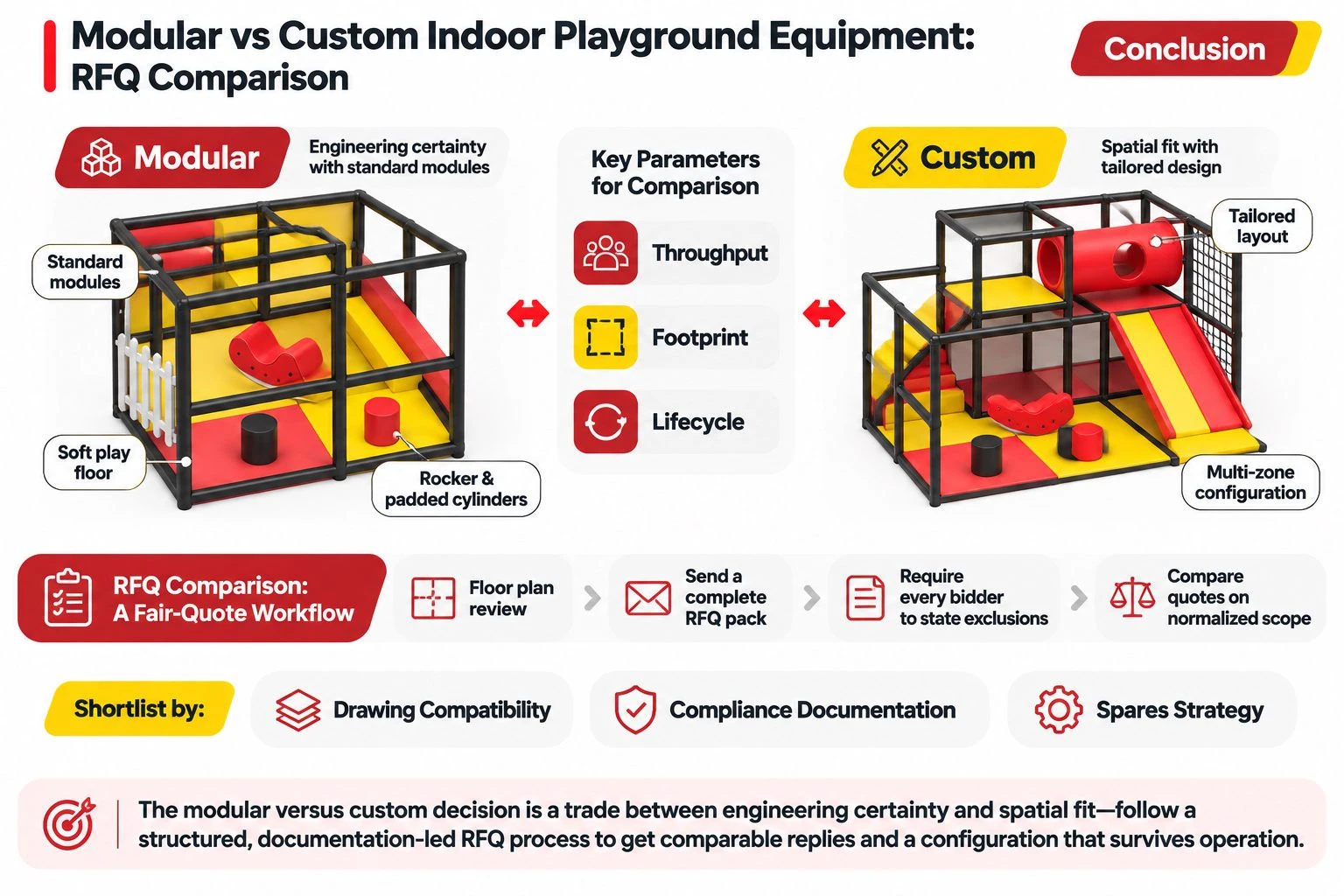
The modular versus custom decision is a trade between engineering certainty and spatial fit. Buyers should shortlist by drawing compatibility, compliance documentation and spares strategy, then compare quotes on normalized scope. Start with a floor plan review, send a complete RFQ pack, and require every bidder to state exclusions. That process produces comparable replies and a configuration that survives operation, not just procurement.