What should be fixed in the brief before you contact suppliers?
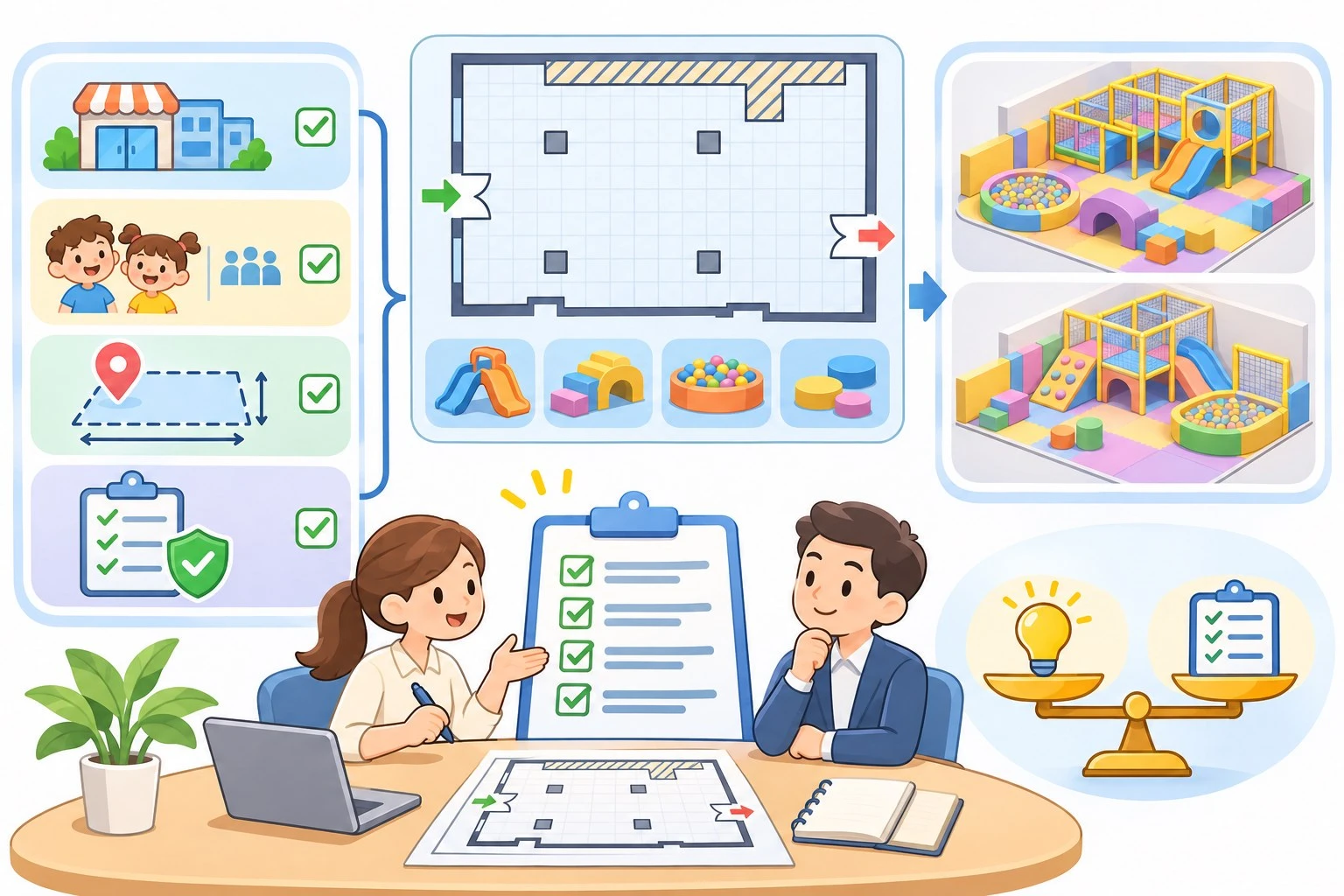
The strongest cost control happens before the first quotation. One import-oriented guide puts it plainly: "Before contacting any supplier, clarify: Purpose of the project (commercial FEC, mall playground, school, etc.), Target age group and expected capacity, Installation location and available space, Compliance requirements based on destination country." It adds that "Clear objectives reduce design changes, cost overruns, and delays." For a toddler zone, that means writing down the upper age limit, the number of children you expect at peak, and whether the area is inside a larger venue or a standalone room.
The trade-off is between flexibility and comparability. A loose brief invites creative proposals that are hard to price side by side; an over-specified brief can lock you into a layout that ignores real constraints such as columns or ceiling obstructions. The practical middle ground is to fix requirements and leave the arrangement open. Provide a floor plan showing entrances, exits, columns and ceiling obstructions, identify the intended age groups and the activities you want, and let suppliers propose the arrangement. The same guidance notes that a design proposal "should distinguish the equipment footprint from the space needed for circulation, access, supervision and maintenance" — a distinction worth making a mandatory submission item.
Compliance belongs in the brief as a question, not an assumption. State the destination country and ask each supplier which standard edition and scope their documentation addresses. Our guide to importing an indoor playground from China walks through the broader process, including how compliance requirements vary by destination. Do not accept a generic certificate as proof that your specific installation will pass local review.
How should the toddler zone be laid out for supervision and cleaning?
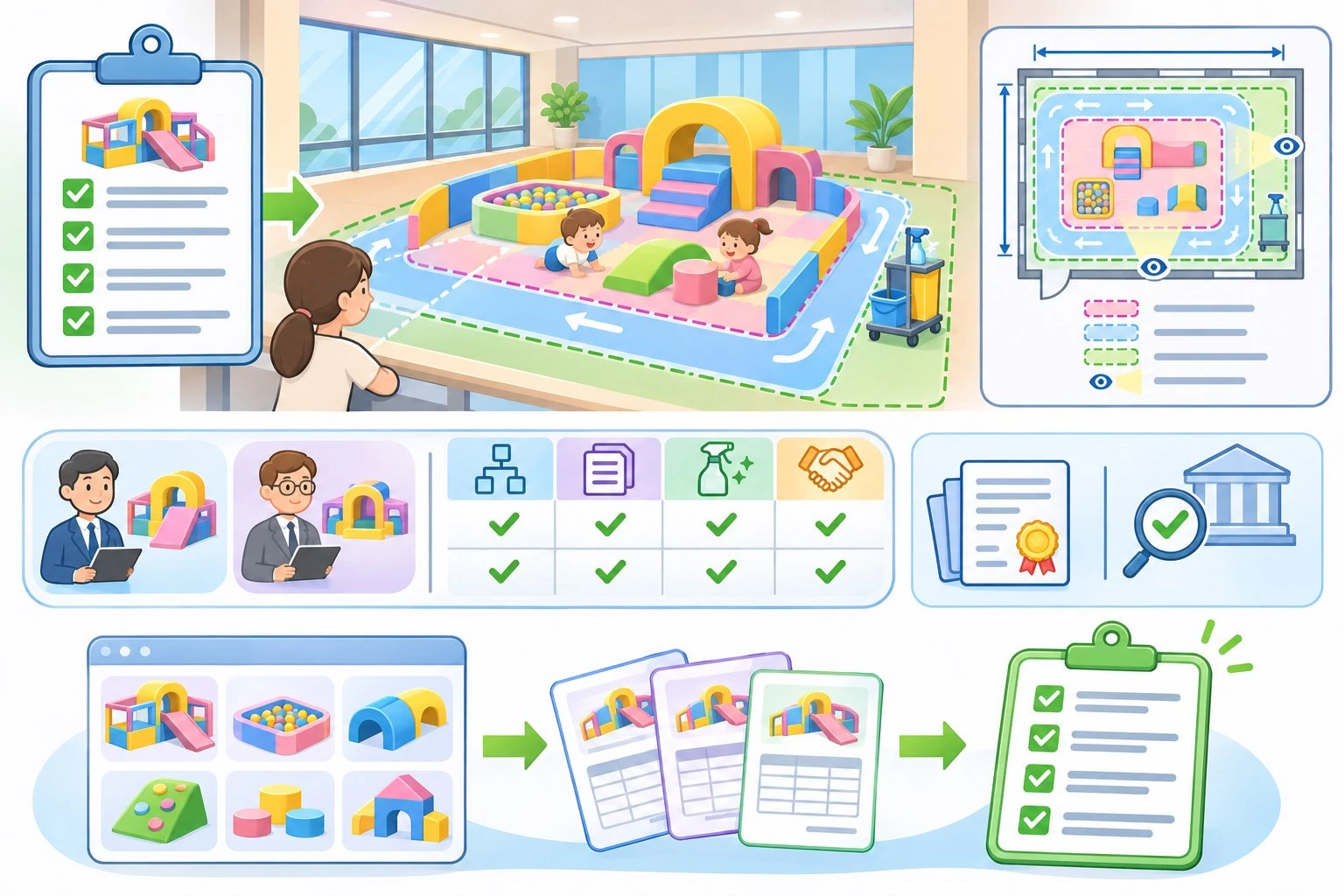
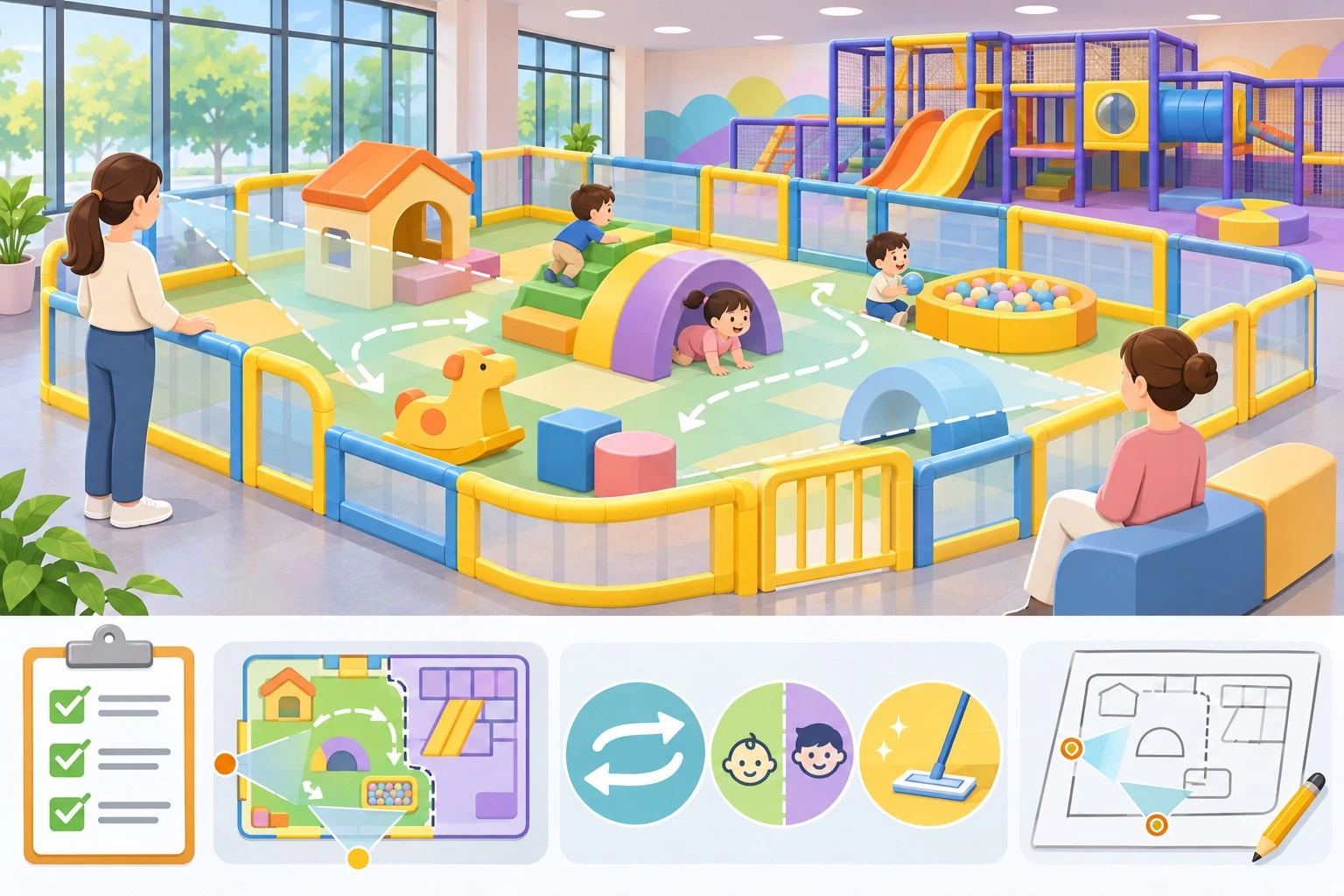
Layout is where toddler areas most often fail in operation. A size and capacity guide lists the checks directly: "Traffic flow: Avoid congestion by spacing equipment; Age zones: Separate areas for toddlers vs. older kids; Maintenance access: Leave space for easy cleaning & repairs." Each of these is a physical allocation of floor area, and each competes with equipment footprint. If a supplier fills the room with soft structures and leaves a narrow perimeter, you have bought equipment and lost an operating zone.
Supervision sightlines deserve explicit treatment because they cannot be retrofitted cheaply. A project reference for a hybrid indoor playground makes the point conditionally: the layout "would need site-specific review of fall areas, supervision sightlines, circulation and local safety requirements." The same reference is careful about what a catalogue can and cannot tell you — it "does not specify installed capacity, clear ceiling height or operating results." Apply that caution to your own tender: ask suppliers to mark caregiver standing positions on the layout and show what a seated adult can see. Treat any claimed capacity figure as a design assumption to be checked against your floor plan, not a verified operating result.
Age zoning is the other structural decision. Separate toddler equipment from older-child routes so that fast traffic does not cross the soft play zone, and position the entrance so caregivers can intercept children leaving the area. For space planning benchmarks, see our guide on how large a small playground needs to be; use its questions — concurrent users, age range, commercial or private use, indoor or outdoor — as inputs to your brief rather than as fixed answers. A published hybrid trampoline and soft play project reference is useful mainly for comparing how activity types are grouped or separated, not as a template for your dimensions.
How do you compare toddler soft play suppliers on evidence?
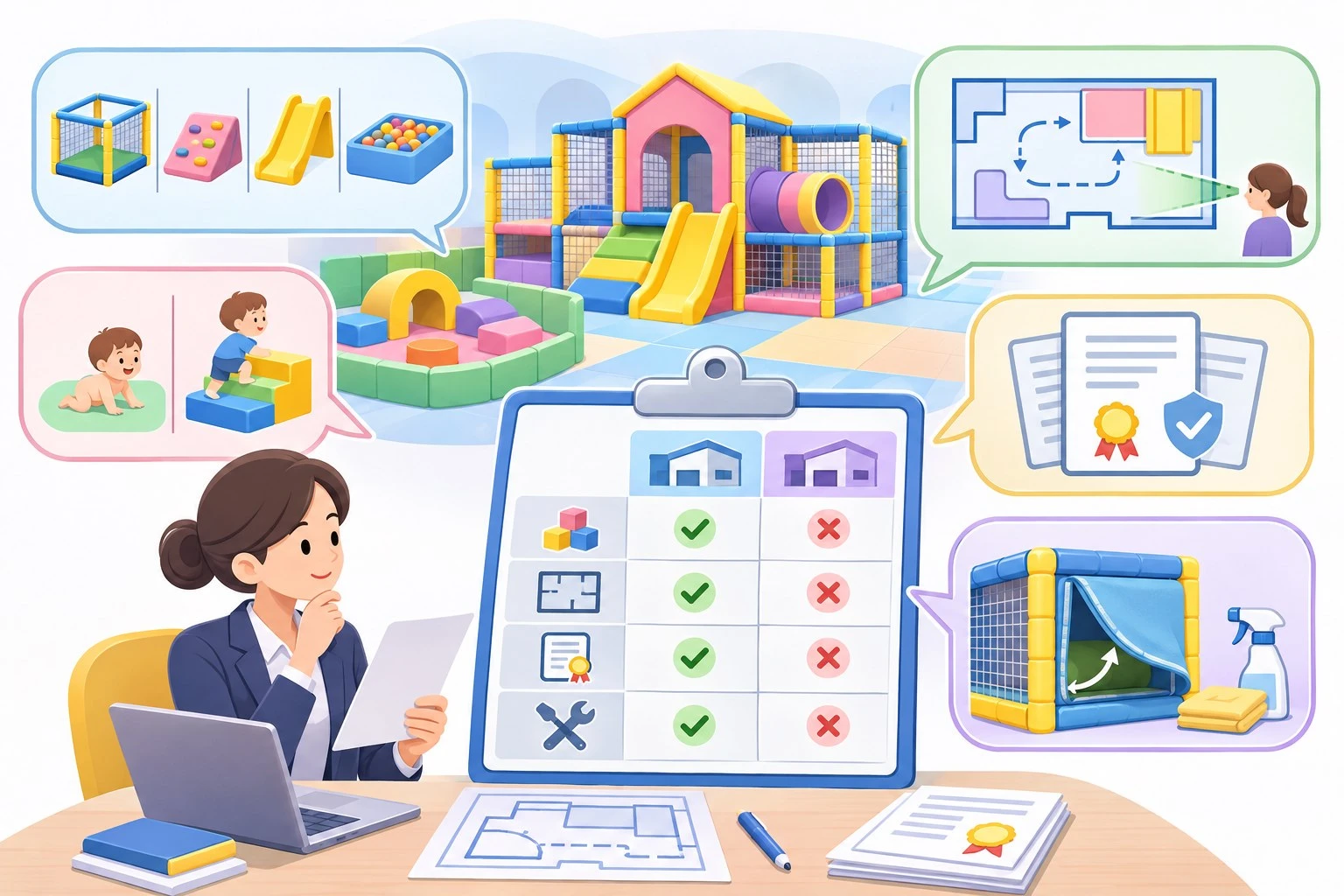
Compare suppliers on submission quality, not presentation quality. The table below sets out evaluation dimensions, what to request, and the trigger that should push you toward or away from an option. It is a buyer-side framework; it does not replace your local code review.
| Evaluation dimension | What to request | Choose this option when… | Avoid or pause when… |
|---|---|---|---|
| Scope definition | Itemised list separating soft-contained play, climbing, slides and any ball play as distinct choices | The supplier prices each activity separately and states what is excluded | The quote is a single lump sum with no scope boundary |
| Layout and supervision | Plan showing footprint, circulation, caregiver sightlines and maintenance access | The proposal distinguishes footprint from circulation and access space | Only rendered images are supplied, with no dimensioned plan |
| Documentation and standards | Test certificates with the standard edition and equipment scope stated | Documents match the exact equipment and destination market | Certificates are generic or the standard edition is unstated |
| Cleaning and maintenance | Access routes for cleaning, replaceable covers, repair procedure | Every enclosed volume can be reached without dismantling | Structures block cleaning access or repairs require major disassembly |
| Installation and handover | Installation plan, inspection checklist, as-built drawings, training | Handover includes a walkthrough and a signed inspection record | Delivery ends at the door with no commissioning step |
Documentation is the dimension most often misread. Guidance on playground standards frames the audience precisely: "Commercial playground operators navigating building inspections and insurance underwriting… International buyers auditing Chinese playground manufacturers' test certificates." It then gives the ordering rule: "Confirm the equipment scope, required standard edition and local review process before ordering. Soft-contained play equipment and trampoline courts need separate scope checks." In practice, a certificate for a trampoline court tells you nothing about your soft play modules, and vice versa. Our comparison of ASTM and EN 1176 playground safety standards explains why the edition and market matter when you audit certificates.
Two conditional triggers are worth building into your scoring. If your team has limited technical capacity, favour suppliers who submit dimensioned layouts and itemised scopes without prompting — you will spend less internal time converting proposals into comparable form. If your project faces insurer or building-department review, weight documentation and handover records more heavily than finish options, because those are the items reviewers will ask for. Neither trigger makes one supplier universally better; they change which evidence you should demand first.
What should installation, inspection and handover cover?
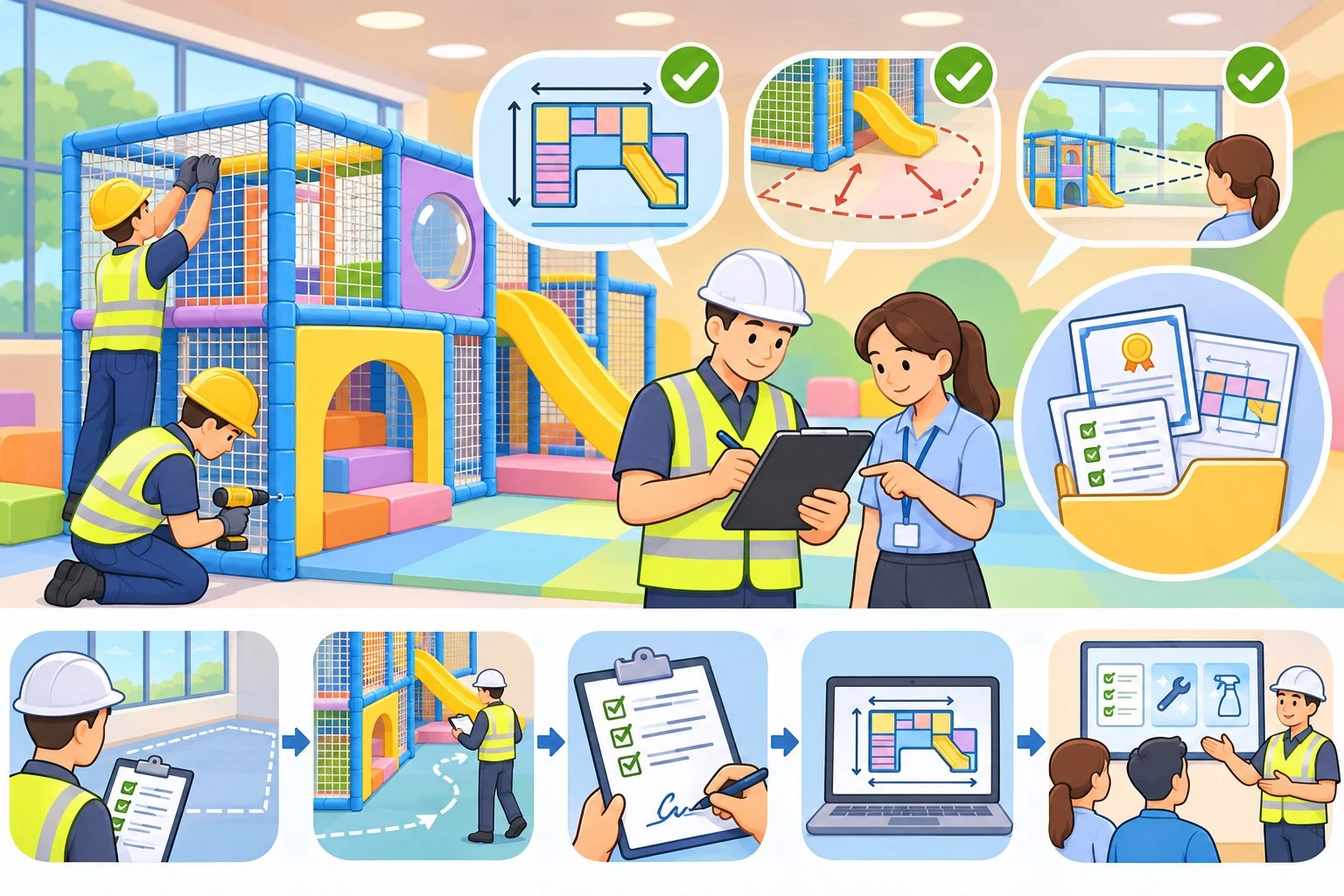
Installation is the point where layout assumptions become visible. Before work starts, confirm that the delivered equipment matches the approved dimensioned plan, that fall areas and circulation zones remain clear once units are placed, and that any site-specific conditions flagged in design review have been resolved. The hybrid project reference again sets the right expectation: fall areas, sightlines, circulation and local safety requirements need site-specific review rather than catalogue assumptions.
Plan the handover as a documented event. A practical sequence: a pre-installation site check against the plan; a walkthrough at completion covering every enclosed volume and cleaning route; a signed inspection record listing what was checked and by whom; as-built drawings reflecting any on-site adjustments; and operator training on daily checks and repair procedures. Keep the supplier's documentation package — certificates with scope and standard edition, the approved layout, and the inspection record — together, because that is the file your insurer or building reviewer will request.
The boundary to respect: your supplier can document the equipment, but only you and your local advisers can confirm that the installation satisfies jurisdiction-specific requirements. Ask the supplier what local review information they can support, and confirm the review process independently.
FAQ
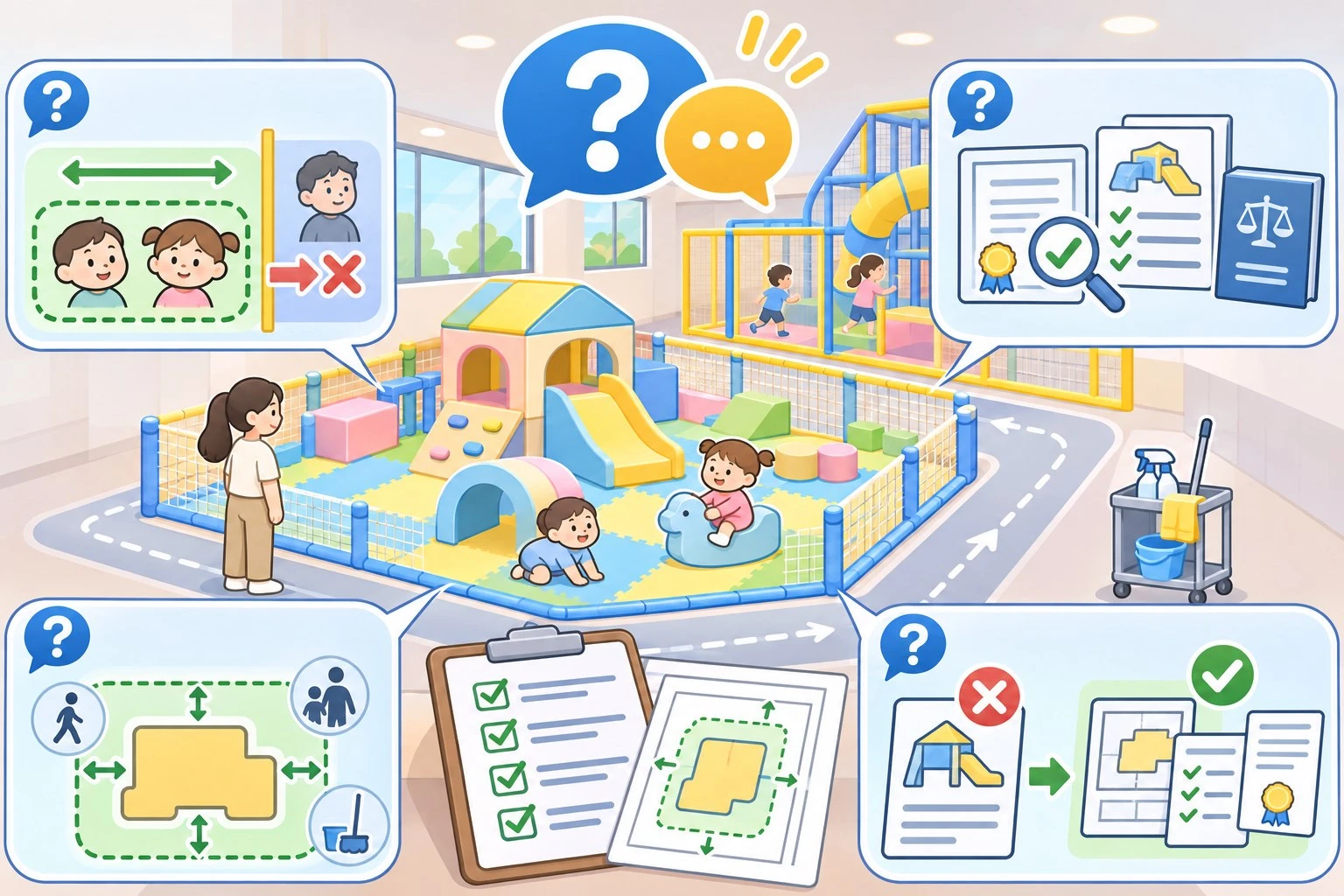
What age range should a dedicated toddler zone serve? Set the upper limit in the brief and zone physically against older-child routes. The exact cut-off is a local and operational decision; the requirement is that it is written down before suppliers design.
Is a supplier's test certificate enough for approval? No. Confirm the equipment scope, the required standard edition and your local review process before ordering, and check that certificates match the specific equipment supplied.
How much space should be left outside the equipment footprint? Enough for circulation, caregiver supervision and cleaning access, shown on the layout. Ask suppliers to draw these zones separately from the equipment footprint rather than quoting a single area figure.
What is the most common procurement mistake? Bundling the toddler zone into a general playground order without its own scope, layout and documentation requirements, which makes proposals hard to compare and gaps expensive to fix later.
Conclusion
Specify the toddler zone as a separate, documented scope: fixed requirements in the brief, an open arrangement, and mandatory submission of a dimensioned layout that separates footprint from circulation, supervision and cleaning space. Compare suppliers on scope definition, documentation, cleaning access and handover — not renders. Keep jurisdiction-specific compliance as your own verification step, with supplier certificates treated as scoped evidence. Buyers who want to see how activity types and equipment categories are presented for comparison can review our commercial indoor play structures range, then apply the checklist above to every quotation received.