Step 1: Confirm the Booking and Send Guest Instructions That Protect the Clock
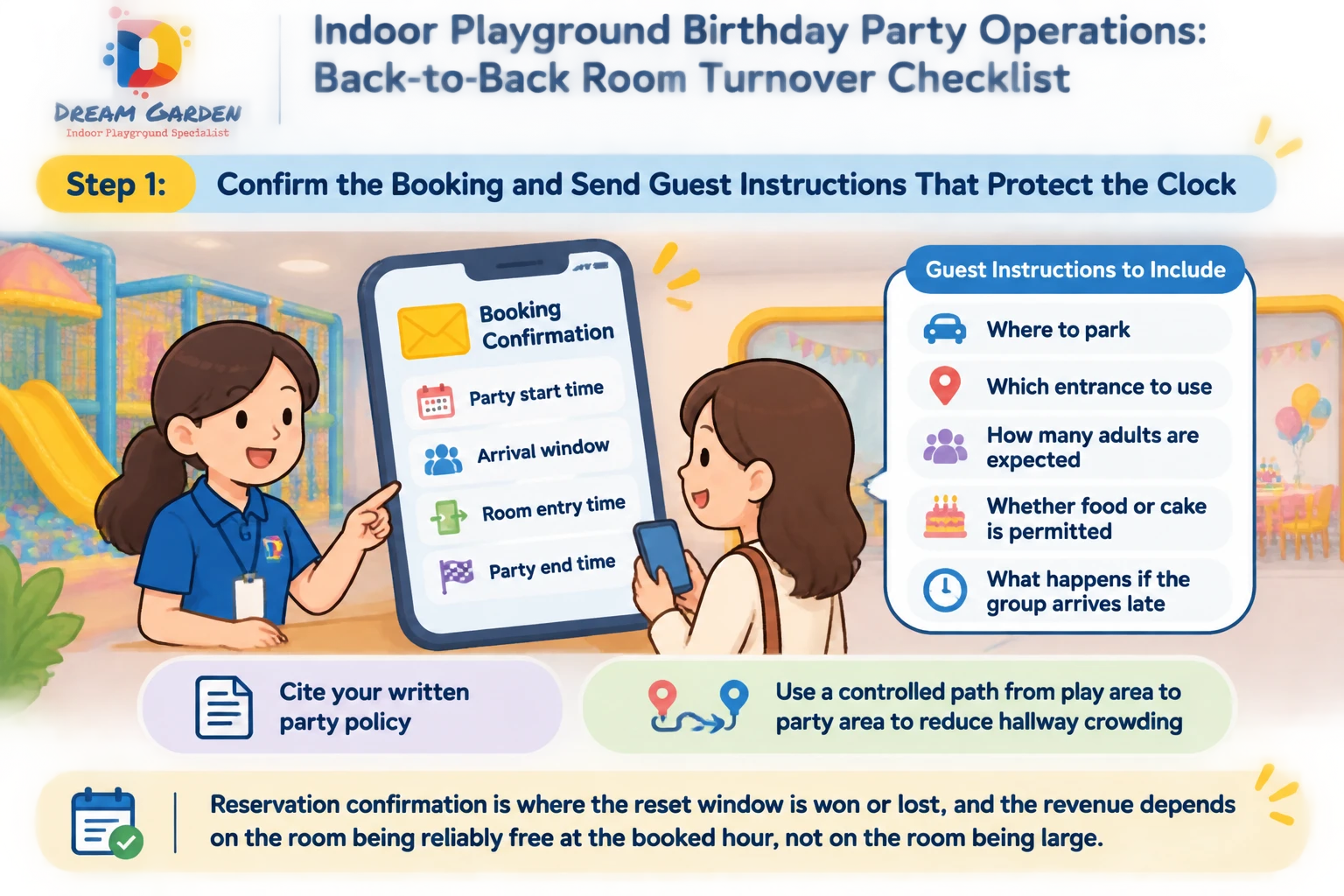
Reservation confirmation is where the reset window is won or lost. The confirmation should state the party start time, the arrival window, the room entry time, and the party end time as separate items. Guests who read only a start time will arrive early, crowd the front desk, and compress the previous group's exit.
Send instructions that answer the questions the front desk would otherwise handle on the day: where to park, which entrance to use, how many adults are expected, whether food or cake is permitted, and what happens if the group arrives late. Keep the language short enough to read on a phone. If your venue publishes a written party policy, cite it in the confirmation so staff and guests work from the same document.
Operators converting underused space into party revenue should note the pattern described in Dream Garden's article on hotel indoor playgrounds: an unrented hall converted into a weekend play lounge can generate recurring revenue through private birthday bookings. The operational lesson is that the revenue depends on the room being reliably free at the booked hour, not on the room being large.
For layout and flow questions that affect how groups move from entry to play floor to party room, see the common operational challenges in indoor playgrounds write-up. Design choices such as a controlled path from play area to party area reduce hallway crowding before any procedure is written.
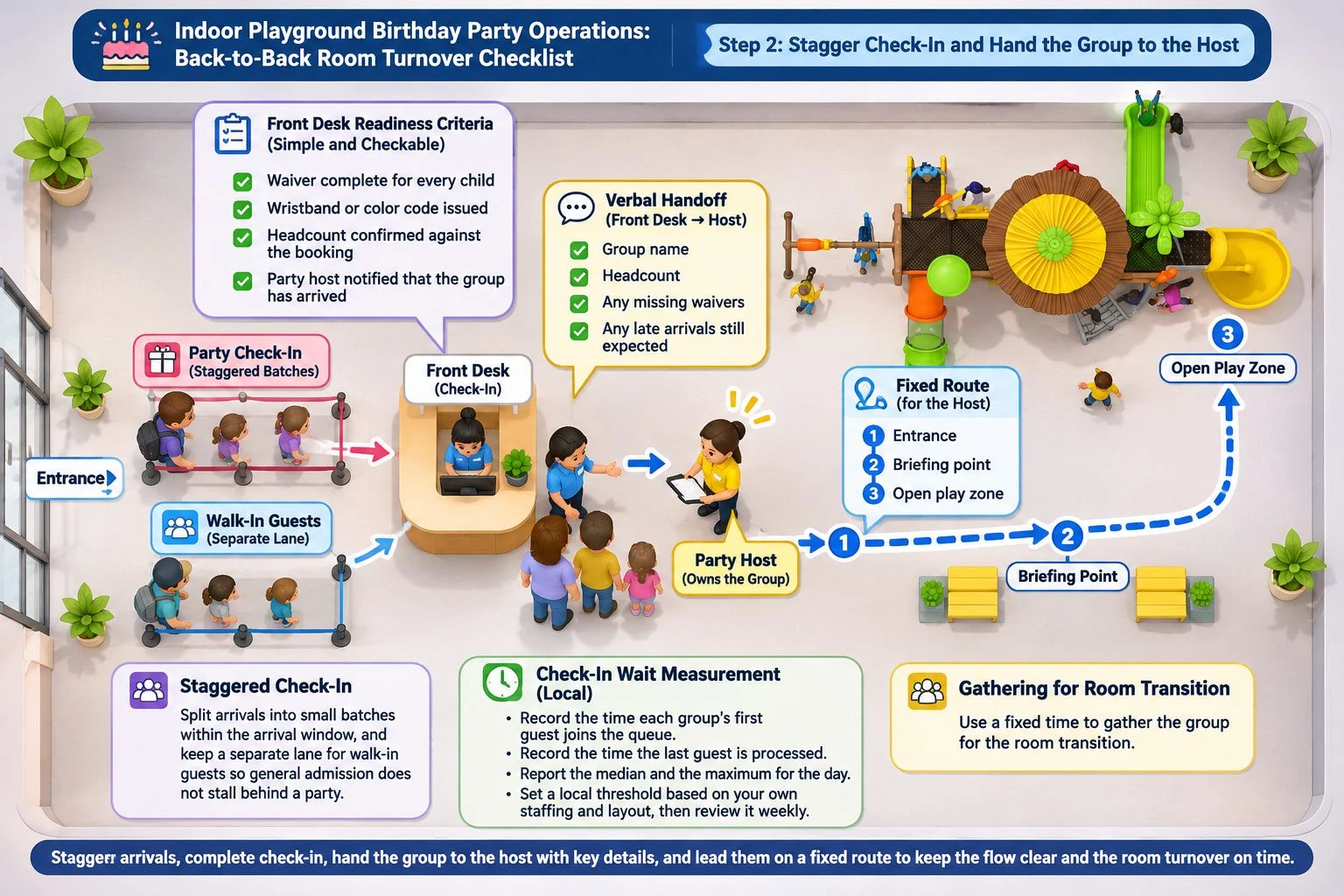
Step 2: Stagger Check-In and Hand the Group to the Host
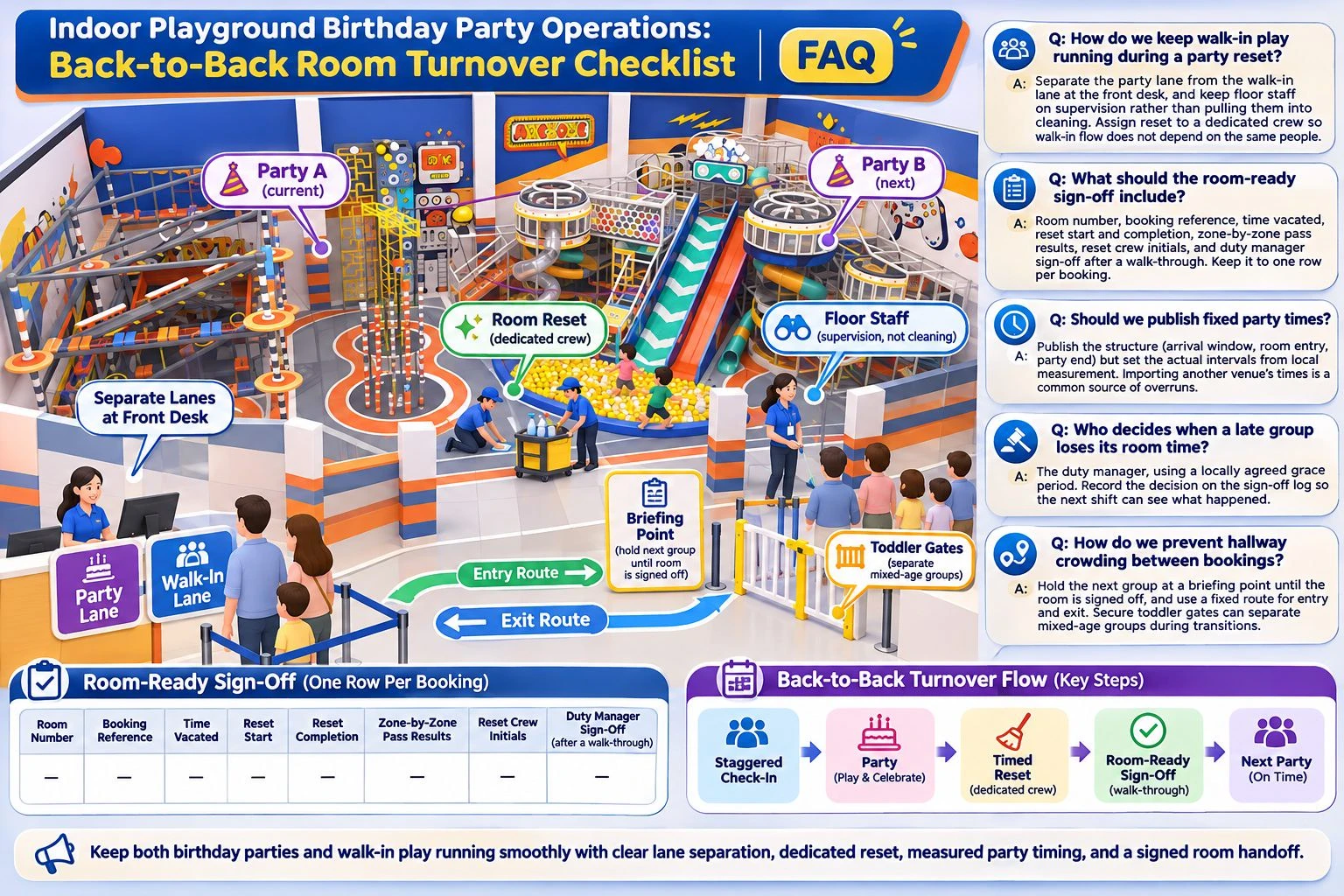
Staggered check-in means the front desk does not process a whole party at once. Split arrivals into small batches within the arrival window, and keep a separate lane or queue for walk-in guests so general admission does not stall behind a party. The front desk's readiness criteria are simple and checkable: waiver complete for every child, wristband or color code issued, headcount confirmed against the booking, and party host notified that the group has arrived.
The handoff from front desk to host should be spoken, not assumed. The front desk tells the host the group name, headcount, any missing waivers, and any late arrivals still expected. The host then owns the group until the room handover.
This is where the complaint pattern from the Dream Garden operations article shows up most often: hosts unsure where to lead families. Give the host a fixed route (entrance, briefing point, open play zone) and a fixed time to gather the group for the room transition. A host who is guessing will improvise, and improvisation is what creates hallway crowding.
Measure check-in wait locally. Record the time each group's first guest joins the queue and the time the last guest is processed. Report the median and the maximum for the day. Do not set a universal target; set a local threshold based on your own staffing and layout, then review it weekly.
Step 3: Move from Open Play to the Party Room Without Blocking Walk-Ins
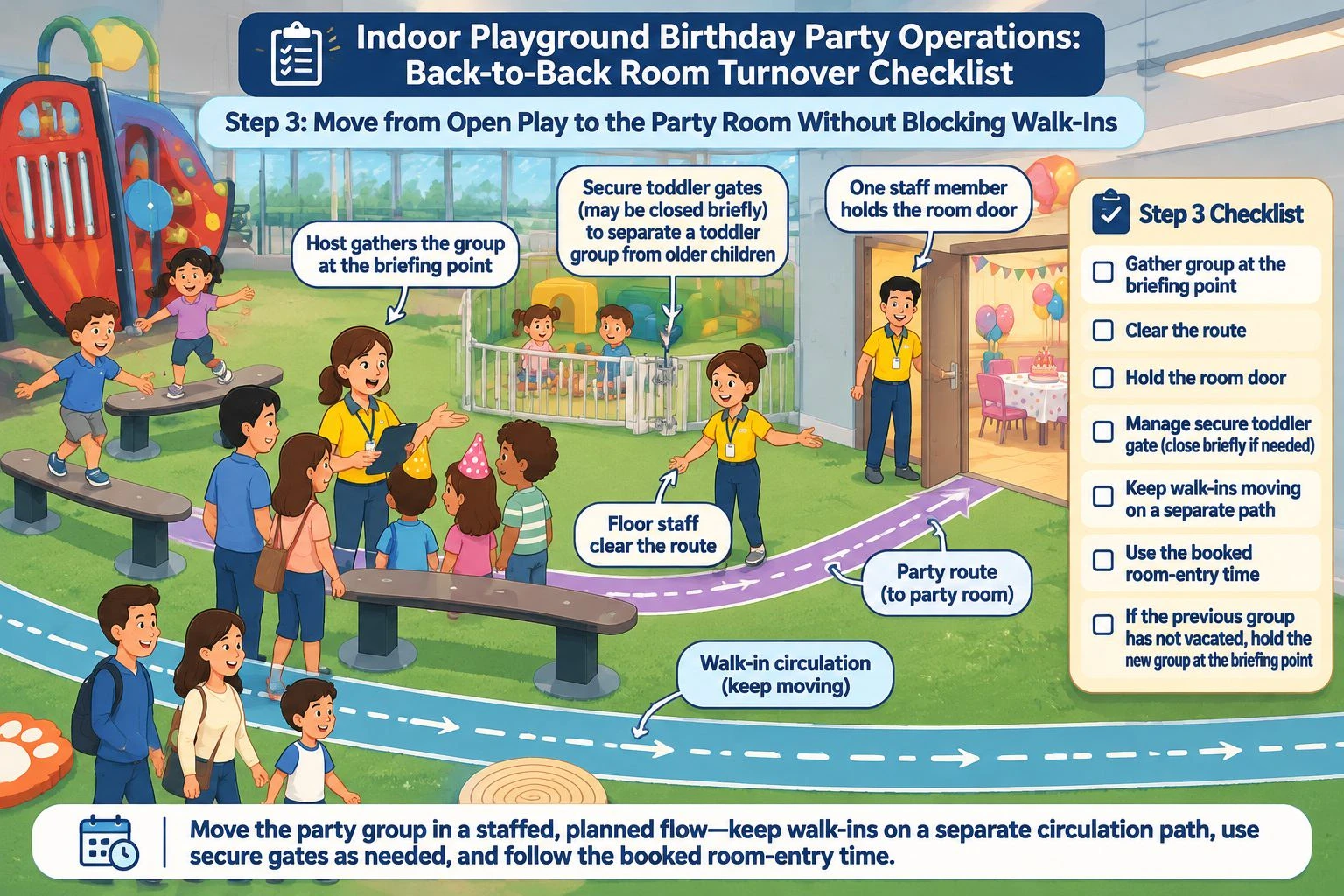
The transition from open play to the party room is a staffing event. The host gathers the group at the briefing point, floor staff clear the route, and one staff member holds the room door. Walk-in guests must keep moving through the play floor during this window, so the party route should not cross the main walk-in circulation path if the layout allows it.
Secure gates matter here. The Dream Garden operations article recommends secure toddler gates to prevent mixed-age collisions. During a party transition, a gate that is normally open may need to be closed briefly to separate a toddler group from older children moving as a pack. Decide in advance who is authorized to close and reopen it.
Set a clear room-entry time in the booking. If the previous group has not vacated, the host holds the new group at the briefing point rather than letting them into the hallway outside the room. This single rule prevents the most common double-booking complaint: guests crowding hallways while staff sort out the room.
For venues planning new party-capable spaces, the custom playground solutions and turnkey project planning page covers how room placement and circulation are set at design stage. The commercial playground projects and case studies collection shows how other operators have laid out party rooms relative to open play.
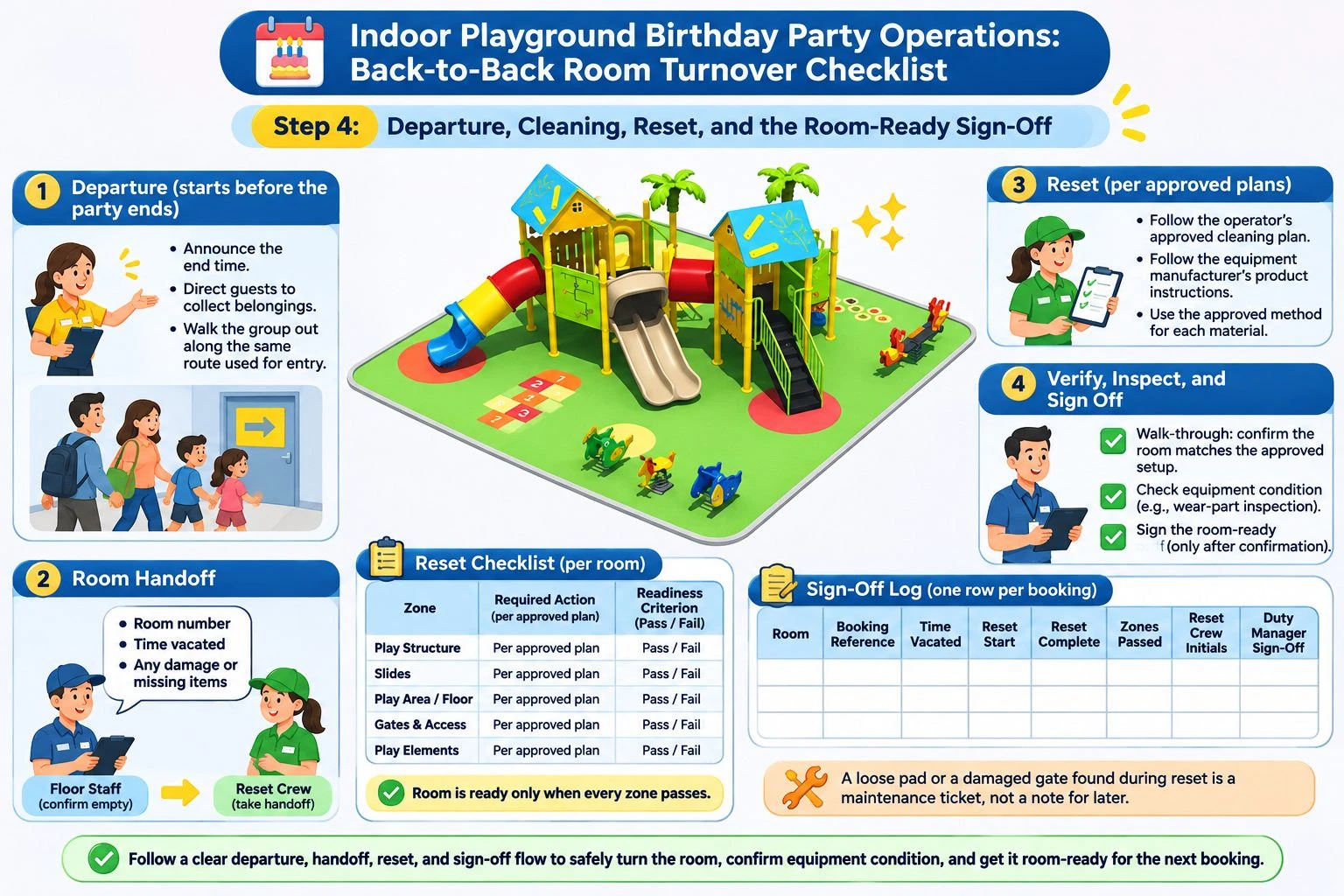
Step 4: Departure, Cleaning, Reset, and the Room-Ready Sign-Off
Departure starts before the party ends. The host announces the end time, directs guests to collect belongings, and walks the group out along the same route used for entry. Floor staff confirm the room is empty, then hand the room to the reset crew with a spoken confirmation: room number, time vacated, and any damage or missing items.
The reset itself follows the operator's approved cleaning plan and the equipment manufacturer's product instructions. Do not invent a cleaning method for a specific surface; use the approved method for that material. The reset checklist should list each zone, the required action, and a pass/fail readiness criterion. A room is ready only when every zone passes.
The sign-off log is deliberately simple. One row per booking, with columns for room, booking reference, time vacated, reset start, reset complete, zones passed, reset crew initials, and duty manager sign-off. The duty manager signs only after a walk-through confirms the room matches the approved setup.
This is also the point where equipment condition is checked. The equipment and industry insights section is a useful reference for wear-part inspection between bookings. A loose pad or a damaged gate found during reset is a maintenance ticket, not a note for later.
Illustrative Timeline (Hypothetical Example)
The timeline below is an explicitly illustrative example for one room with two weekend bookings. The intervals are placeholders; replace them with locally measured values.
| Clock | Guests (Booking A) | Staff |
|---|---|---|
| 10:00 | Arrival window opens; first guests check in | Front desk staggers check-in; host notified |
| 10:20 | Group gathered at briefing point | Host takes over; floor staff clear route |
| 10:30 | Open play in assigned zone | Host supervises group; walk-in lane stays open |
| 11:15 | Group moves to party room | Host leads; door staff holds room entry |
| 12:15 | Party ends; guests collect belongings | Host walks group out; floor staff confirm empty |
| 12:20 | Booking B guests begin arriving | Reset crew starts; front desk staggers B check-in |
| 12:50 | Booking B group gathered at briefing point | Reset complete; duty manager signs off |
| 13:00 | Booking B enters party room | Host takes over Booking B group |
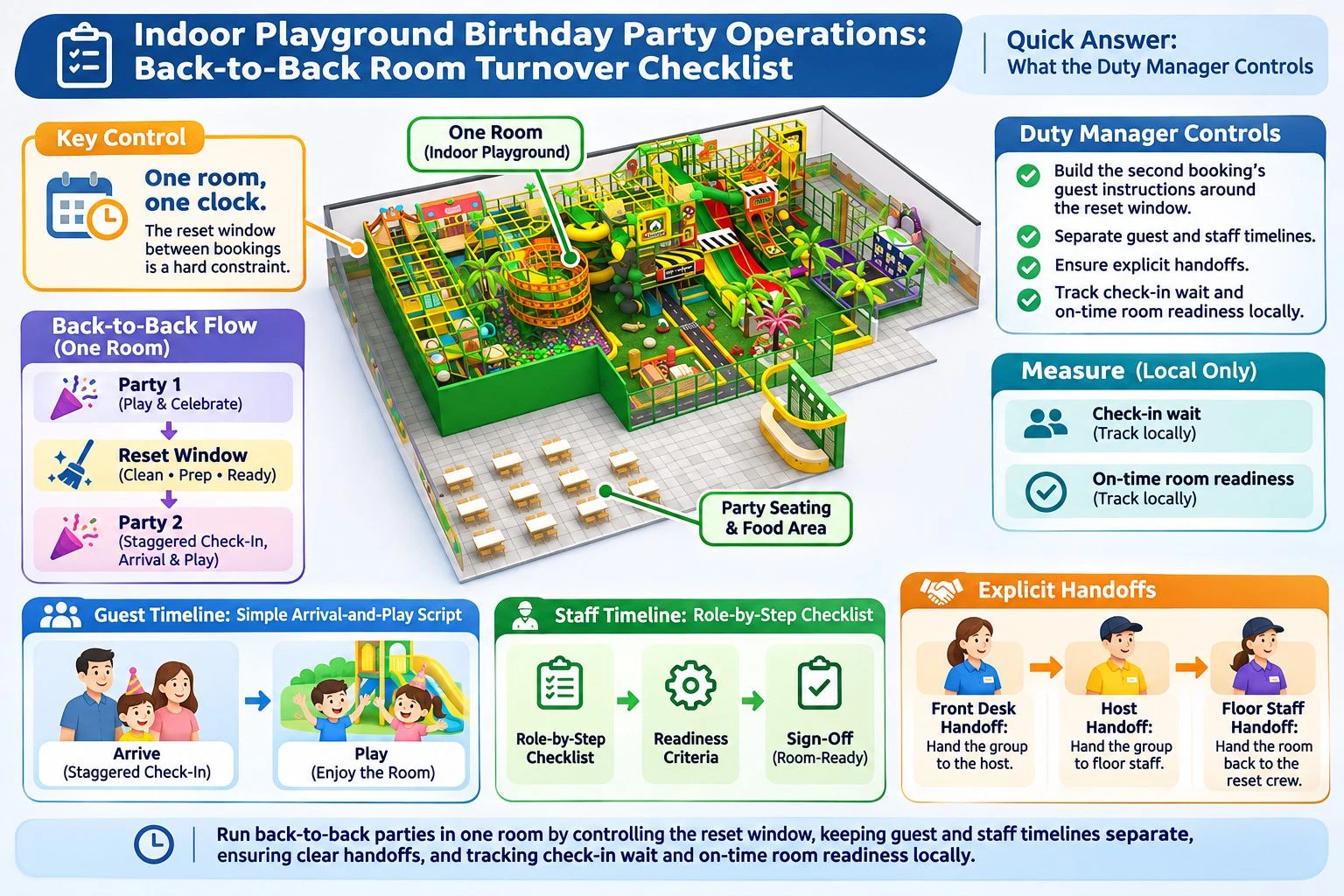
Notice that Booking B's guest timeline runs in parallel with Booking A's reset. The two groups never share the hallway, and the front desk never processes two parties at the same moment.
Step 5: Escalation for Late Arrivals and Delayed Resets
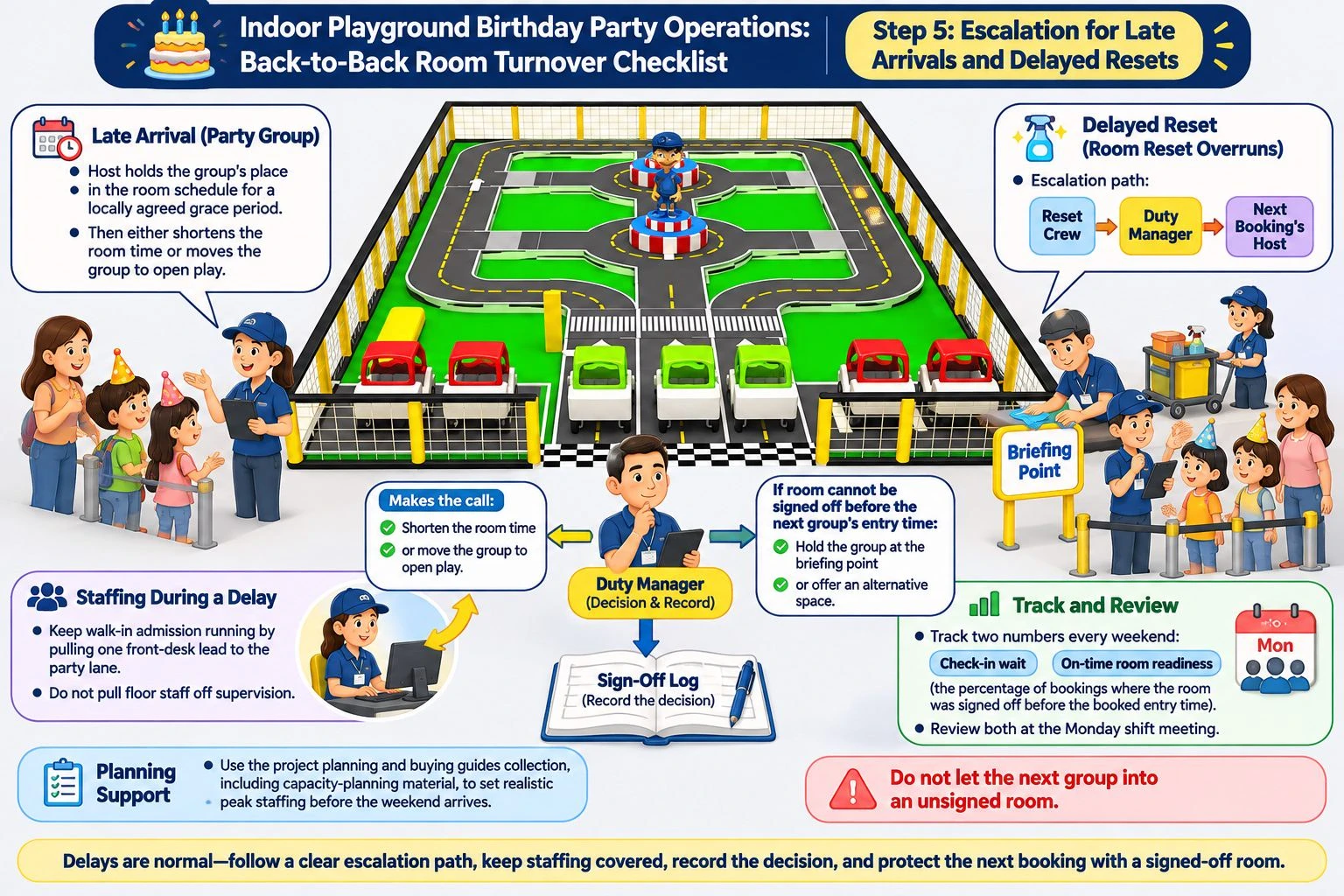
Delays are normal. The procedure should say what happens, who decides, and when the next booking is notified. For a late arrival, the host holds the group's place in the room schedule for a locally agreed grace period, then either shortens the room time or moves the group to open play. The duty manager makes the call and records it on the sign-off log.
For a delayed reset, the escalation path runs from reset crew to duty manager to the next booking's host. If the room cannot be signed off before the next group's entry time, the duty manager decides between holding the group at the briefing point and offering an alternative space. Do not let the next group into an unsigned room.
Staffing coverage during a delay is the hard part. Keep walk-in admission running by pulling one front-desk lead to the party lane rather than pulling floor staff off supervision. The project planning and buying guides collection includes capacity-planning material that helps set realistic peak staffing before the weekend arrives.
Track two numbers every weekend: check-in wait and on-time room readiness (the percentage of bookings where the room was signed off before the booked entry time). Review both at the Monday shift meeting. A falling readiness figure is an early warning that the reset window is too short for the approved cleaning plan.
FAQ
How do we keep walk-in play running during a party reset?
Separate the party lane from the walk-in lane at the front desk, and keep floor staff on supervision rather than pulling them into cleaning. Assign reset to a dedicated crew so walk-in flow does not depend on the same people.
What should the room-ready sign-off include?
Room number, booking reference, time vacated, reset start and completion, zone-by-zone pass results, reset crew initials, and duty manager sign-off after a walk-through. Keep it to one row per booking.
Should we publish fixed party times?
Publish the structure (arrival window, room entry, party end) but set the actual intervals from local measurement. Importing another venue's times is a common source of overruns.
Who decides when a late group loses its room time?
The duty manager, using a locally agreed grace period. Record the decision on the sign-off log so the next shift can see what happened.
How do we prevent hallway crowding between bookings?
Hold the next group at a briefing point until the room is signed off, and use a fixed route for entry and exit. Secure toddler gates can separate mixed-age groups during transitions.
Conclusion: Protect the Next Booking First
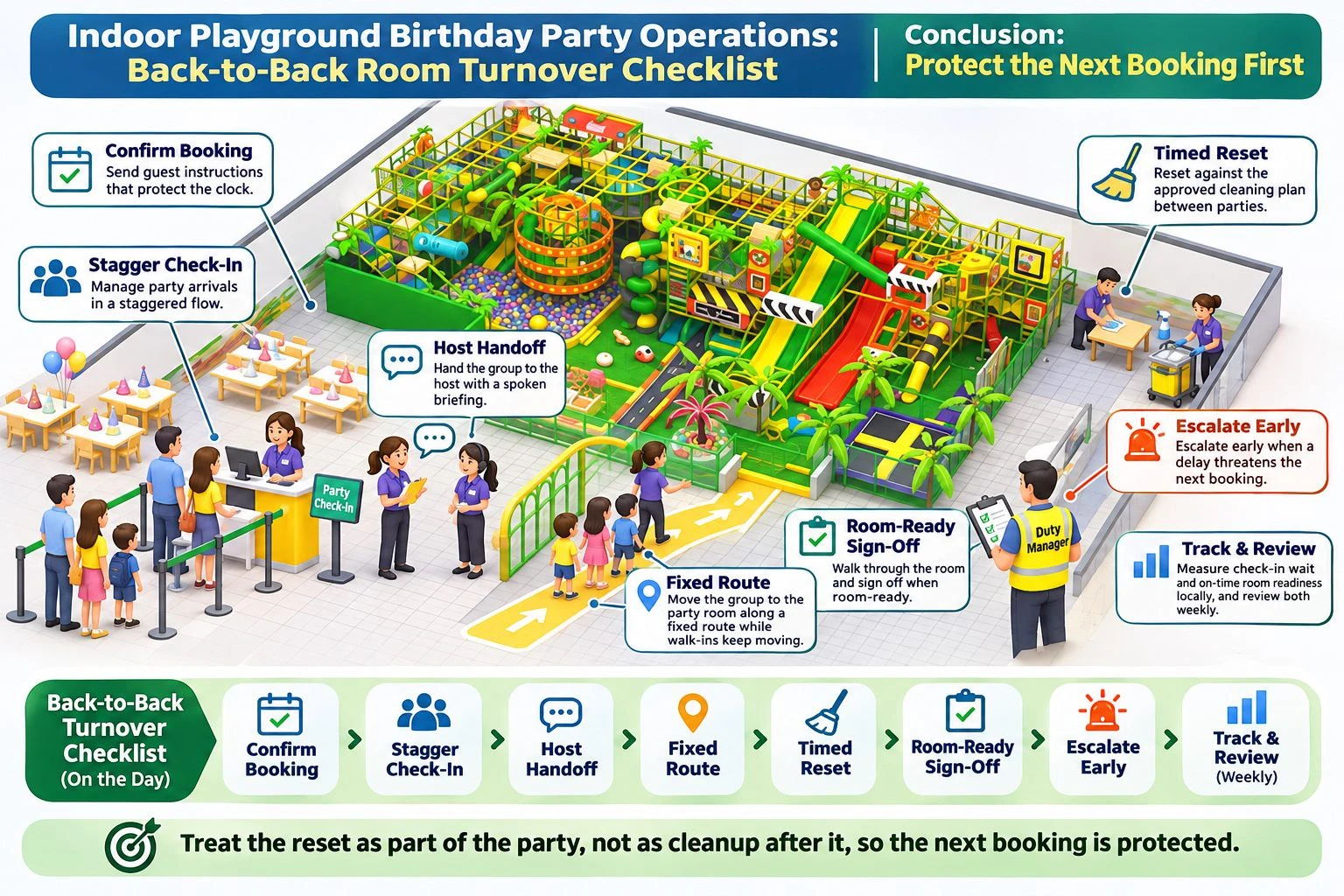
Back-to-back birthday parties work when the duty manager treats the reset as part of the party, not as cleanup after it. Confirm the booking with guest instructions that protect the clock. Stagger check-in and hand the group to the host with a spoken briefing. Move the group to the room along a fixed route while walk-ins keep moving. Reset against the approved cleaning plan, sign off after a walk-through, and escalate early when a delay threatens the next booking.
Measure check-in wait and on-time room readiness locally, and review both weekly. For broader context on how party-room placement and circulation are set at design stage, browse the playground guides and news archive. The procedure above is the part your team controls on the day.