
How do clear height, structural load and peak duty cycle constrain an adult ninja obstacle course?
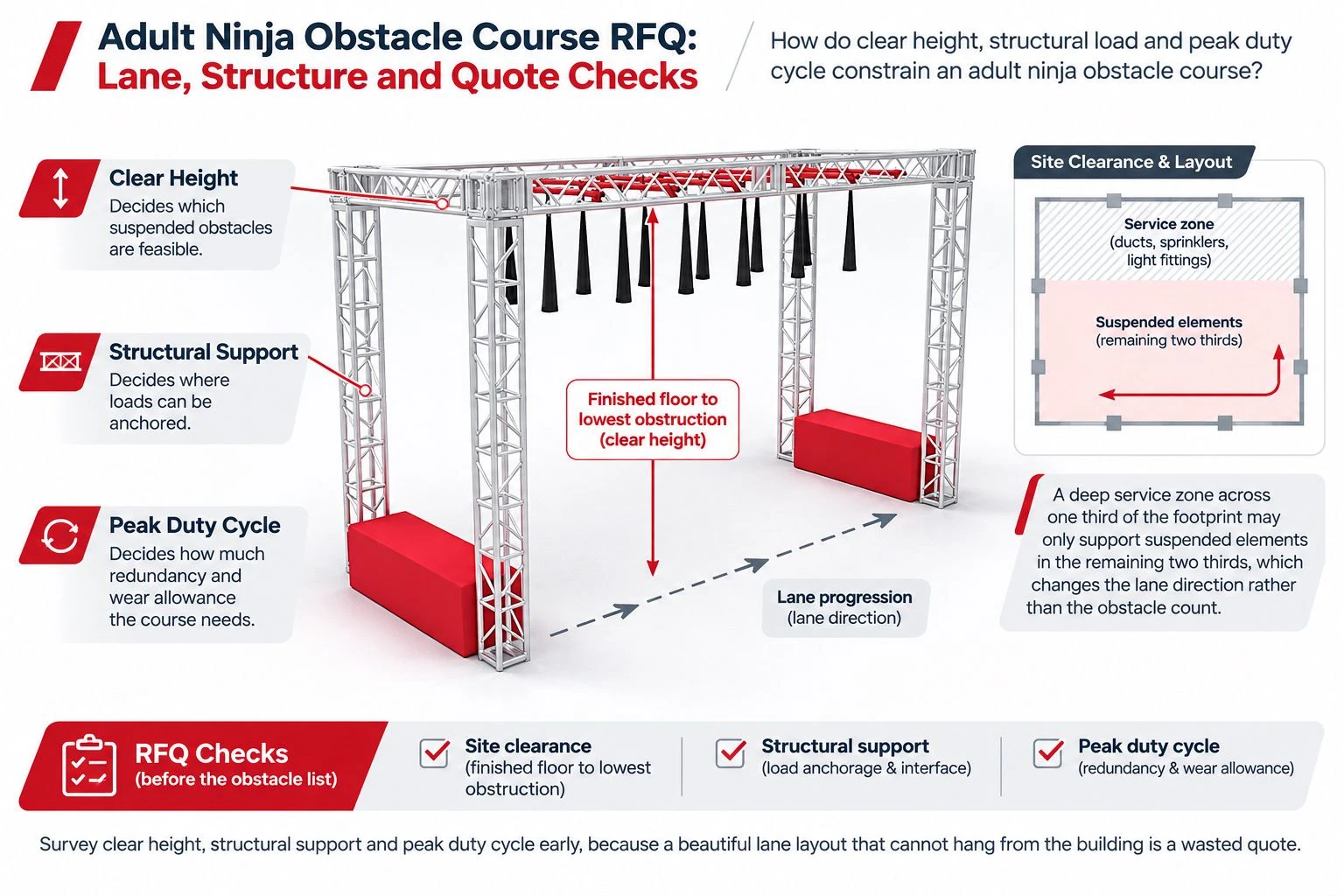
Site clearance, structural load and peak duty cycle are the three constraints that most often force a redesign of an adult ninja obstacle course after the concept is agreed. Clear height decides which suspended obstacles are feasible; structural support decides where loads can be anchored; duty cycle decides how much redundancy and wear allowance the course needs. I survey all three before I discuss obstacle lists, because a beautiful lane layout that cannot hang from the building is a wasted quote.
Clear height and the overhead envelope
Suspended challenges need headroom above the participant and space for the support structure itself. I ask the venue for the finished floor to lowest obstruction dimension, not the nominal ceiling height, and I mark columns, ducts, sprinklers and light fittings on the plan. A hypothetical example: a hall with generous nominal height but a deep service zone across one third of the footprint may only support suspended elements in the remaining two thirds, which changes the lane direction rather than the obstacle count.
Structural support and the interface line
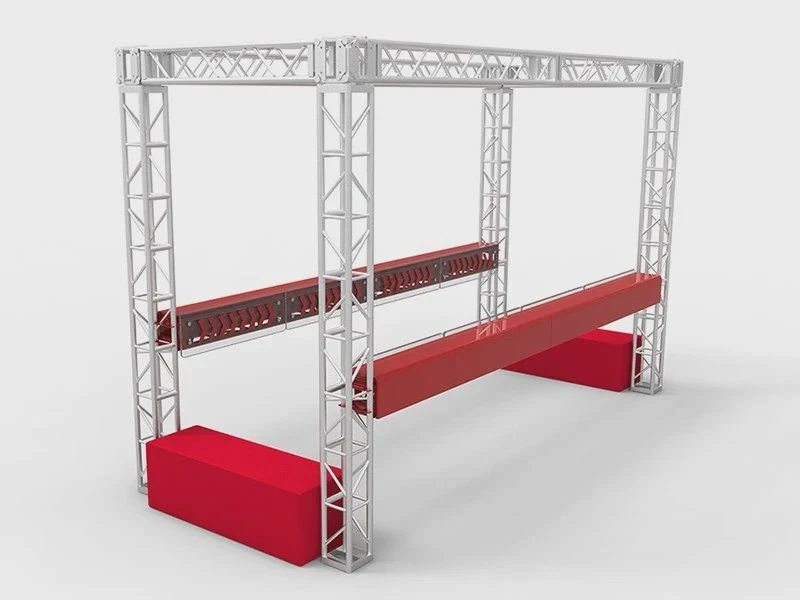
Overhead support structure is part of the course, but the interface with the building must be explicit. I want the supplier to state whether anchors are into a primary steel frame, a secondary rail system, or a freestanding frame, and to show the load path on a drawing. Dream Garden's configuration pages describe suspended challenges, ground-level obstacles and an overhead support structure as elements of the course reference, while noting that final connections and structure belong in the coordinated design. That is the correct division: the supplier owns the course structure, the venue owns the building, and the drawing must show where one stops and the other begins.
Peak duty cycle
Duty cycle is the combination of participants per hour, session length and turnaround. A course sized for continuous adult traffic needs more wear allowance on high-contact elements and a faster reset between groups than a course used in short booked slots. I ask for the assumed throughput in the proposal, because a quote that silently assumes half the traffic of another will look cheaper without being comparable.
For operator-side safety planning, the International Adventure & Trampoline Park Association standards and research resources[1] are a useful starting point for the questions to raise with suppliers; they do not replace the project-specific design and local approvals.
How should beginner and advanced lanes, changeover and routing be specified?
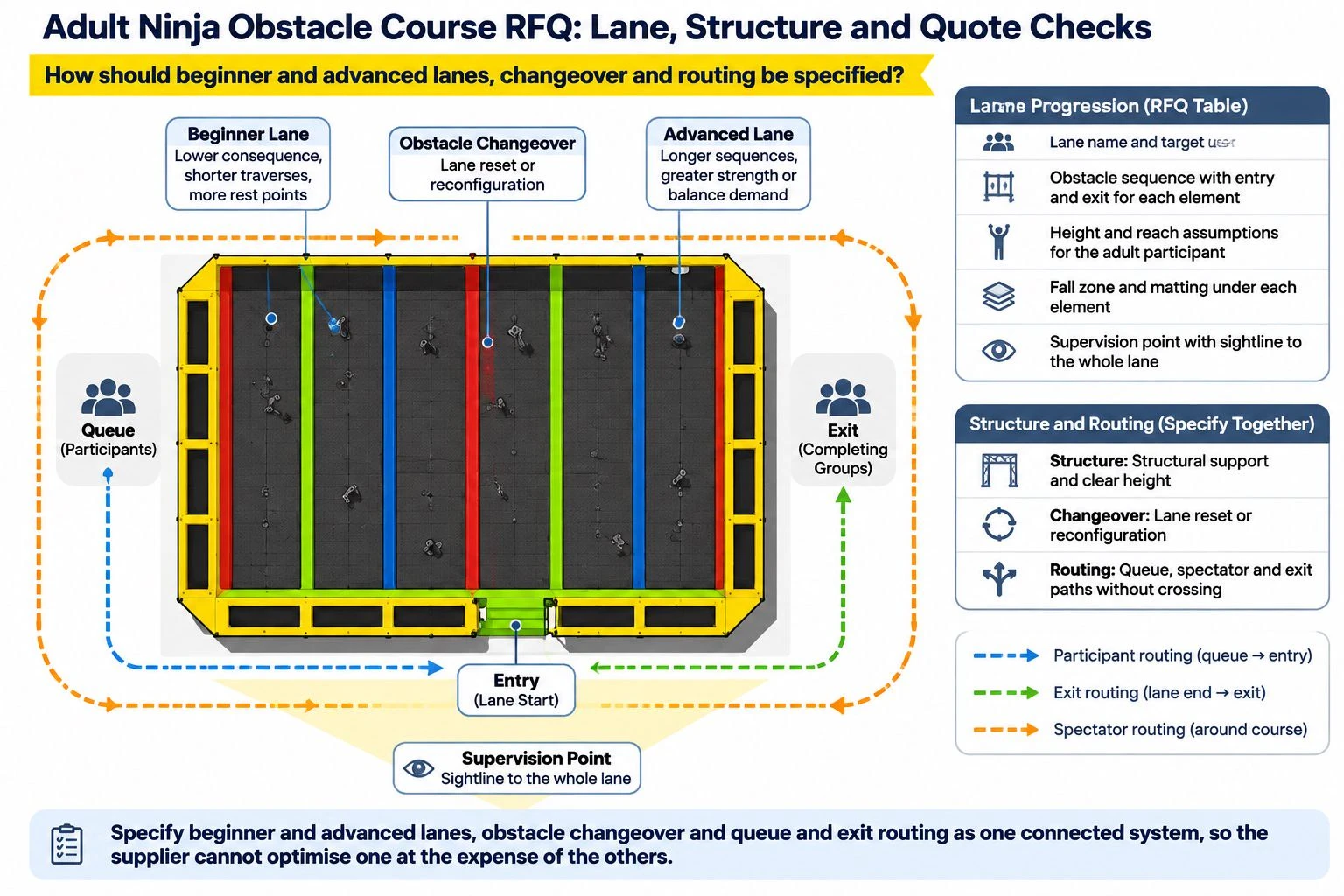
Beginner and advanced lanes, obstacle changeover and queue and exit routing should be specified as one connected system, because each constrains the others. Lane progression determines the obstacle mix; changeover determines how quickly a lane can be reset or reconfigured; routing determines whether spectators, queuing participants and exiting groups cross each other. I specify all three on the same drawing so the supplier cannot optimise one at the expense of the others.
Lane progression
A common structure is a beginner lane with lower consequence, shorter traverses and more rest points, and an advanced lane with longer sequences and greater strength or balance demand. Dream Garden describes ninja courses as obstacle courses that challenge and improve strength, endurance, coordination, agility and balance, and notes customisation for adults and children. In a brief, I translate that into a progression table:
- Lane name and target user.
- Obstacle sequence with entry and exit for each element.
- Height and reach assumptions for the adult participant.
- Fall zone and matting under each element.
- Supervision point with sightline to the whole lane.
Obstacle changeover
Changeover matters commercially. If the venue wants to rotate obstacles seasonally or convert a beginner lane to advanced for events, the mounting system must allow it without cutting or re-welding structure. I ask suppliers to describe the changeover method, the tools required, the downtime per element, and whether spare mounts are included. A course with fixed welded elements may be cheaper to buy and more expensive to keep interesting.
Queue and exit routing
Routing is a safety and throughput issue, not a layout nicety. I check that the queue does not back into the landing zone of the previous obstacle, that the exit route does not cross the entry route, and that a participant who stops mid-course can be reached without entering another lane. A hypothetical example: two lanes sharing one exit stair can create a bottleneck at peak, so I would ask for separate exit paths or a wider shared route with a defined merge point.
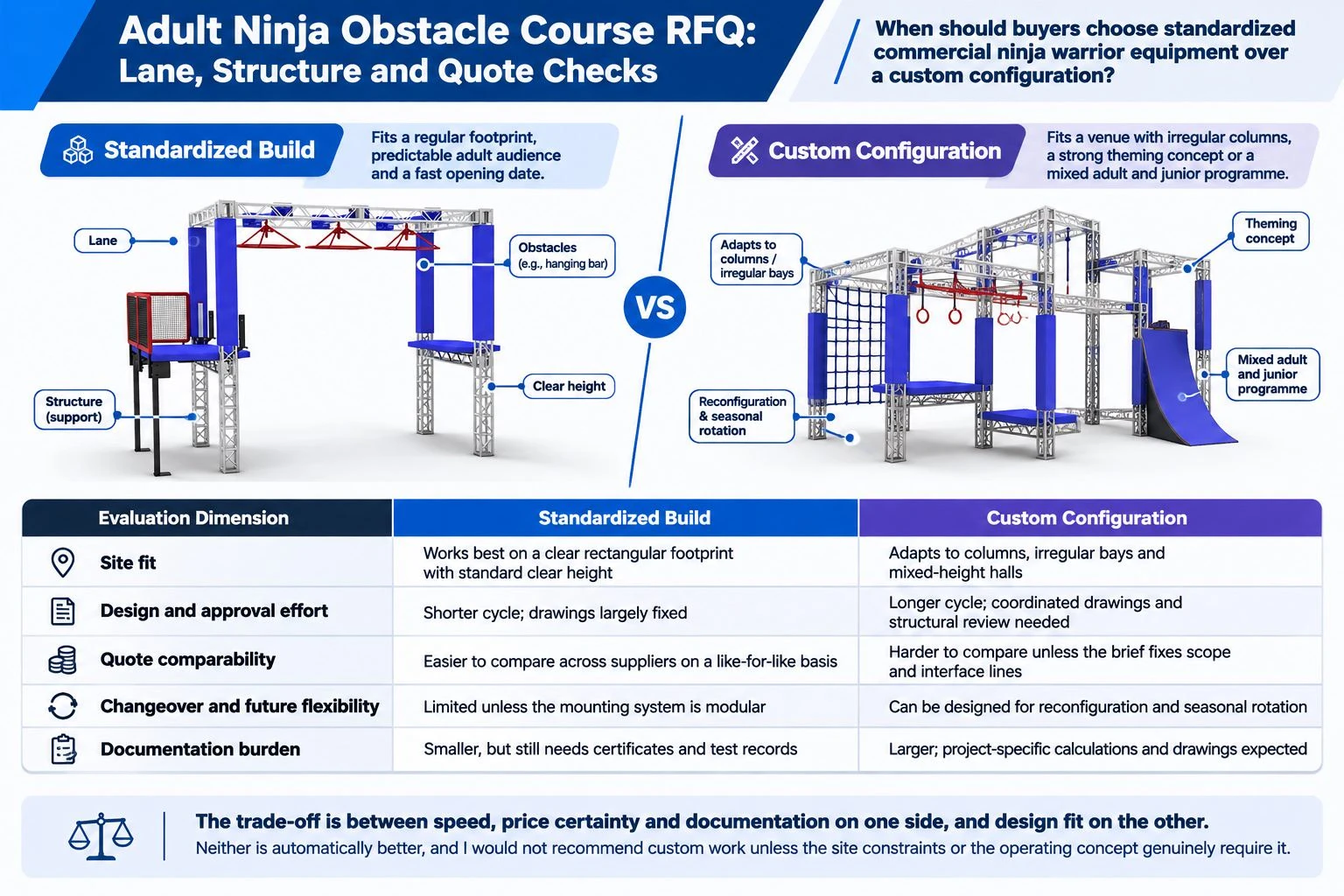
When should buyers choose standardized commercial ninja warrior equipment over a custom configuration?
Standardized commercial ninja warrior equipment fits a venue with a regular footprint, a predictable adult audience and a fast opening date; a custom configuration fits a venue with irregular columns, a strong theming concept or a mixed adult and junior programme. The trade-off is between speed, price certainty and documentation on one side, and design fit on the other. Neither is automatically better, and I would not recommend custom work unless the site constraints or the operating concept genuinely require it.
| Evaluation dimension | Standardized build | Custom configuration |
|---|---|---|
| Site fit | Works best on a clear rectangular footprint with standard clear height | Adapts to columns, irregular bays and mixed-height halls |
| Design and approval effort | Shorter cycle; drawings largely fixed | Longer cycle; coordinated drawings and structural review needed |
| Quote comparability | Easier to compare across suppliers on a like-for-like basis | Harder to compare unless the brief fixes scope and interface lines |
| Changeover and future flexibility | Limited unless the mounting system is modular | Can be designed for reconfiguration and seasonal rotation |
| Documentation burden | Smaller, but still needs certificates and test records | Larger; project-specific calculations and drawings expected |
My decision rule is simple. If the site survey shows a clean footprint and the operator wants to open quickly, I would shortlist standardized or lightly adapted builds and spend the saved effort on operating procedures. If the survey shows structural obstructions or the operator plans events and rotating themes, I would go custom and accept the longer drawing cycle. Dream Garden's custom professional ninja warrior obstacle course page is an example of the custom route, while the suspended obstacles ninja course page shows how a reference configuration is presented before the coordinated design is fixed.
Which drawings, certificates and factory acceptance tests should buyers verify before ordering?
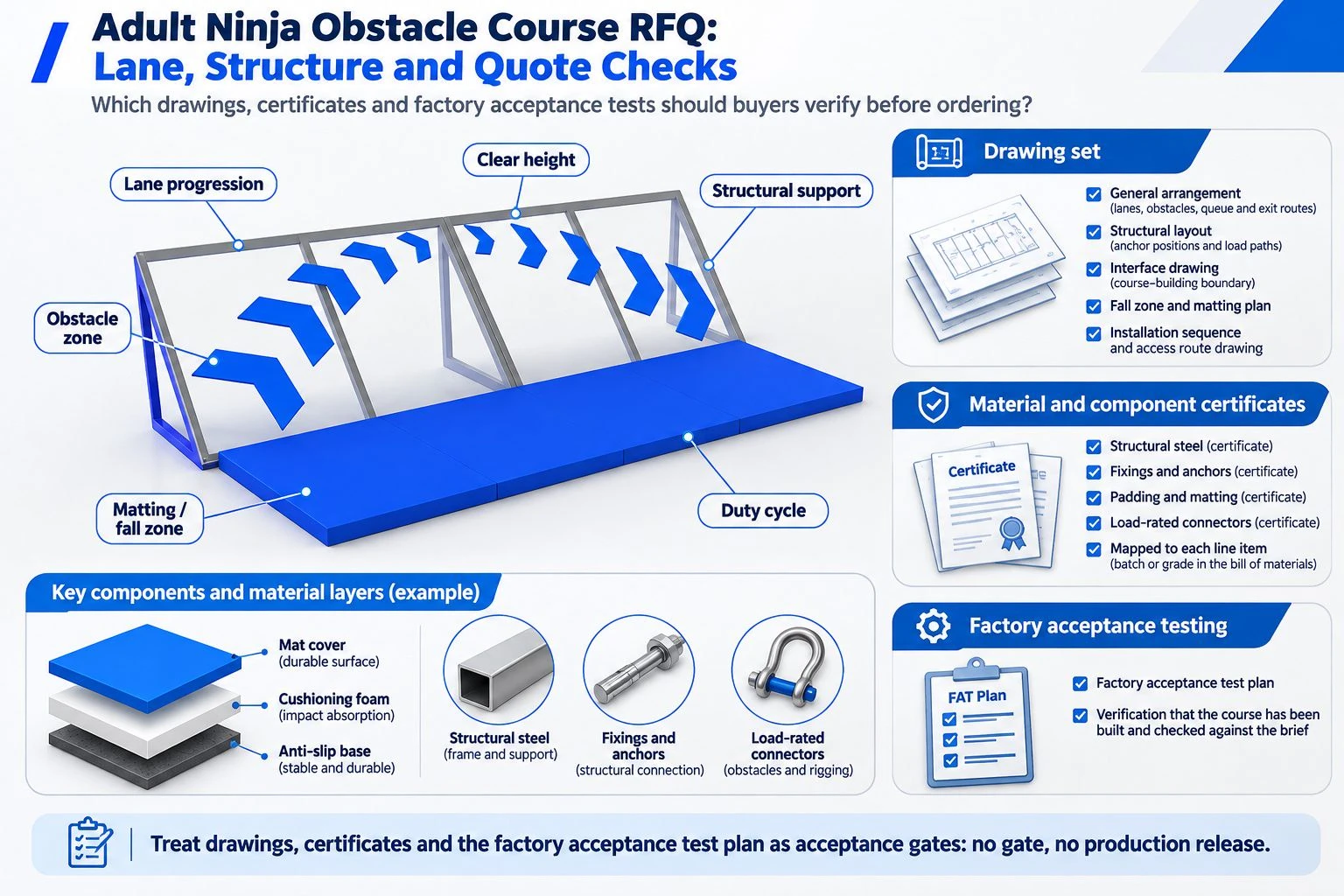
Buyers should verify a defined drawing set, material and component certificates, and a factory acceptance test plan before releasing an indoor obstacle course for adults to production. The purpose is not to collect paperwork but to confirm that the supplier has designed, built and checked the course against the brief. I treat these as acceptance gates: no gate, no production release.
Drawing set
- General arrangement showing lanes, obstacles, queue and exit routes.
- Structural layout with anchor positions and load paths.
- Interface drawing marking the boundary between course structure and building structure.
- Fall zone and matting plan.
- Installation sequence and access route drawing.
Material and component evidence
I ask for certificates for structural steel, fixings and anchors, padding and matting, and any load-rated connectors, matched to the components actually specified. A generic certificate for a material family is weaker than a certificate tied to the batch or grade in the bill of materials, so I ask the supplier to map each certificate to a line item.
Factory acceptance testing
A factory acceptance test plan should list what is checked before shipment: dimensional conformity to drawings, weld and fixing inspection, padding coverage, and a trial assembly of at least one representative lane section where practical. I ask for the signed test record with the shipment. Dream Garden's custom ninja product page states that qualification and supporting reports should be confirmed in the proposal, which is exactly the clause I would make a condition of order rather than an afterthought.
For licensed public entertainment venues, local conditions can add requirements such as a clearly marked emergency switch and documented operating procedures; the South Lanarkshire Council public entertainment licence conditions[2] illustrate the kind of operator-facing obligations that should be checked against your own jurisdiction. They are an example, not a universal standard.
How should I compare adult ninja obstacle course quotes line by line?
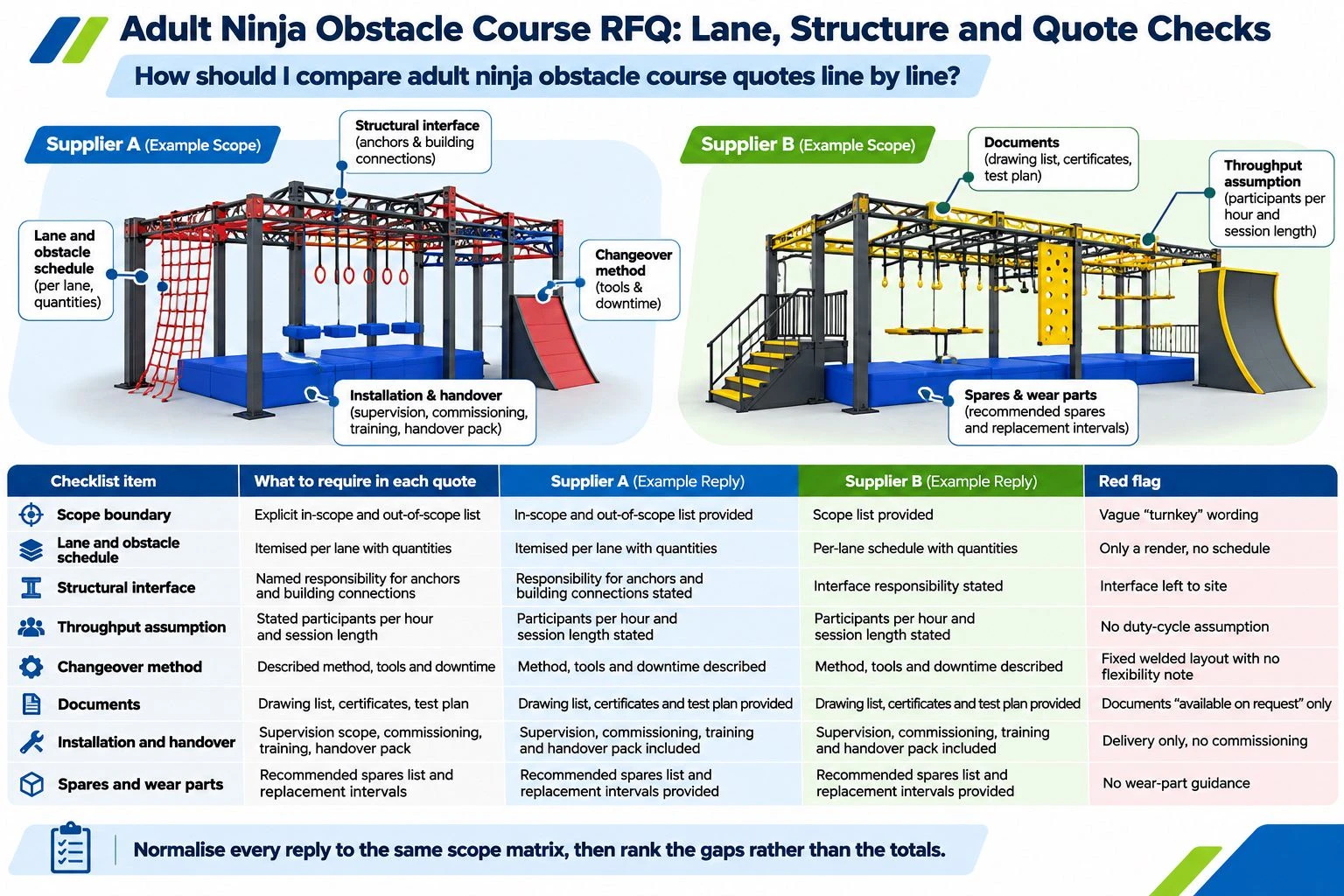
I compare adult ninja obstacle course quotes by normalising every reply to the same scope matrix, then ranking the gaps rather than the totals. The lowest total is meaningless if one supplier excludes installation, structural steel or padding. The checklist below is the one I use in evaluation meetings.
| Checklist item | What to require in each quote | Red flag |
|---|---|---|
| Scope boundary | Explicit in-scope and out-of-scope list | Vague "turnkey" wording |
| Lane and obstacle schedule | Itemised per lane with quantities | Only a render, no schedule |
| Structural interface | Named responsibility for anchors and building connections | Interface left to site |
| Throughput assumption | Stated participants per hour and session length | No duty-cycle assumption |
| Changeover method | Described method, tools and downtime | Fixed welded layout with no flexibility note |
| Documents | Drawing list, certificates, test plan | Documents "available on request" only |
| Installation and handover | Supervision scope, commissioning, training, handover pack | Delivery only, no commissioning |
| Spares and wear parts | Recommended spares list and replacement intervals | No wear-part guidance |
Two hypothetical replies illustrate the method. Supplier A quotes a lower total but excludes structural steel and matting; once those are added, its total rises and its scope still lacks a test plan. Supplier B quotes higher but includes the interface drawing, certificates mapped to the bill of materials and a commissioning visit. On a like-for-like basis, B is the stronger commercial offer even before technical scoring, because the risk it leaves with the buyer is smaller.
I also score how each supplier responds to a clarification request. A supplier that answers with a revised drawing and a marked-up scope is easier to manage than one that answers with prose. Dream Garden's indoor adventure park equipment range for ninja and ropes courses and the wider commercial playground equipment catalog are useful references when building the scope matrix, because they show the categories a quote should itemise.
What changes my recommendation?
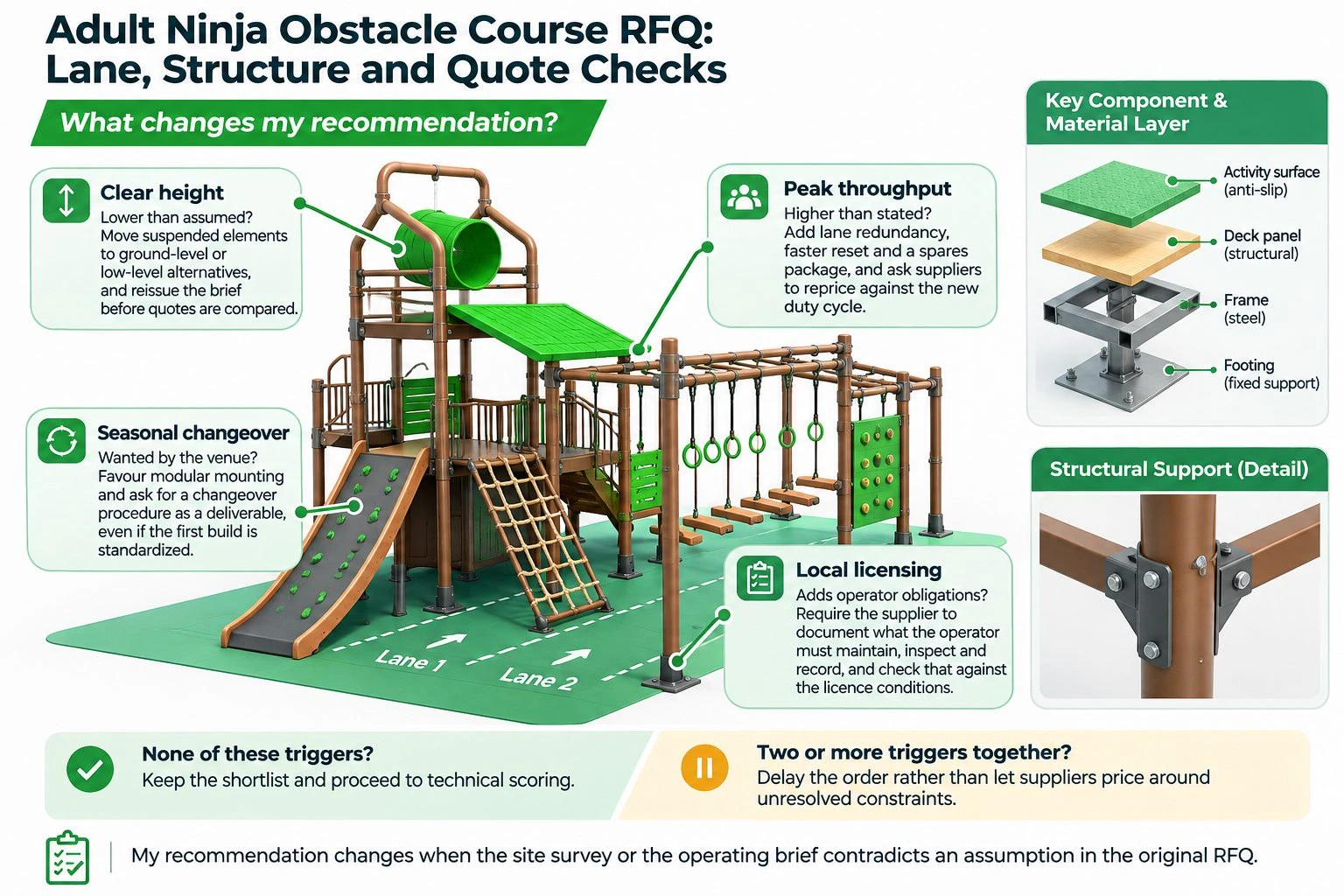
My recommendation changes when the site survey or the operating brief contradicts an assumption in the original RFQ. Four triggers matter most.
- Clear height comes in lower than assumed: I move suspended elements to ground-level or low-level alternatives and reissue the brief before quotes are compared.
- Peak throughput is higher than stated: I add lane redundancy, faster reset and a spares package, and I ask suppliers to reprice against the new duty cycle.
- The venue wants seasonal changeover: I favour modular mounting and ask for a changeover procedure as a deliverable, even if the first build is standardized.
- Local licensing adds operator obligations: I require the supplier to document what the operator must maintain, inspect and record, and I check that against the licence conditions.
If none of these triggers appears, I keep the shortlist and proceed to technical scoring. If two or more appear together, I would delay the order rather than let suppliers price around unresolved constraints.
Frequently asked questions
What is the minimum information needed for an adult ninja obstacle course RFQ?
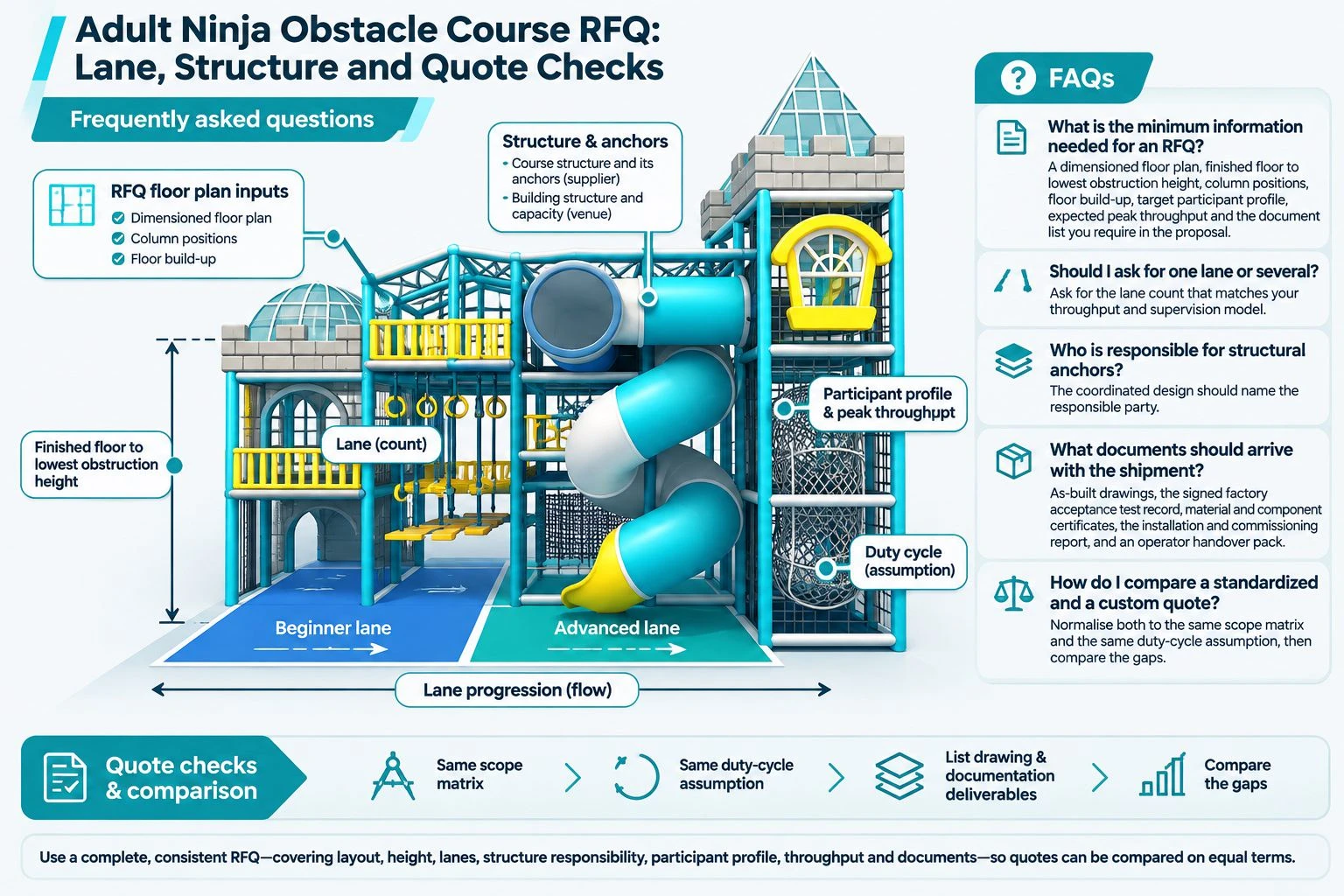
A dimensioned floor plan, finished floor to lowest obstruction height, column positions, floor build-up, target participant profile, expected peak throughput and the document list you require in the proposal. Without these, quotes will not compare on equal terms.
Should I ask for one lane or several?
Ask for the lane count that matches your throughput and supervision model, and ask each supplier to justify the count against your stated participants per hour. A single advanced lane can serve a small booked-session venue; a busy FEC usually needs parallel beginner and advanced lanes.
Who is responsible for structural anchors?
The coordinated design should name the responsible party. In most briefs the supplier owns the course structure and its anchors, and the venue owns the building structure and confirms its capacity. The interface drawing must show the boundary.
What documents should arrive with the shipment?
As-built drawings, the signed factory acceptance test record, material and component certificates mapped to the bill of materials, the installation and commissioning report, and an operator handover pack covering inspection points and wear parts.
How do I compare a standardized and a custom quote?
Normalise both to the same scope matrix and the same duty-cycle assumption, then compare the gaps. A custom quote is only comparable once its drawing and documentation deliverables are listed as line items.
Conclusion
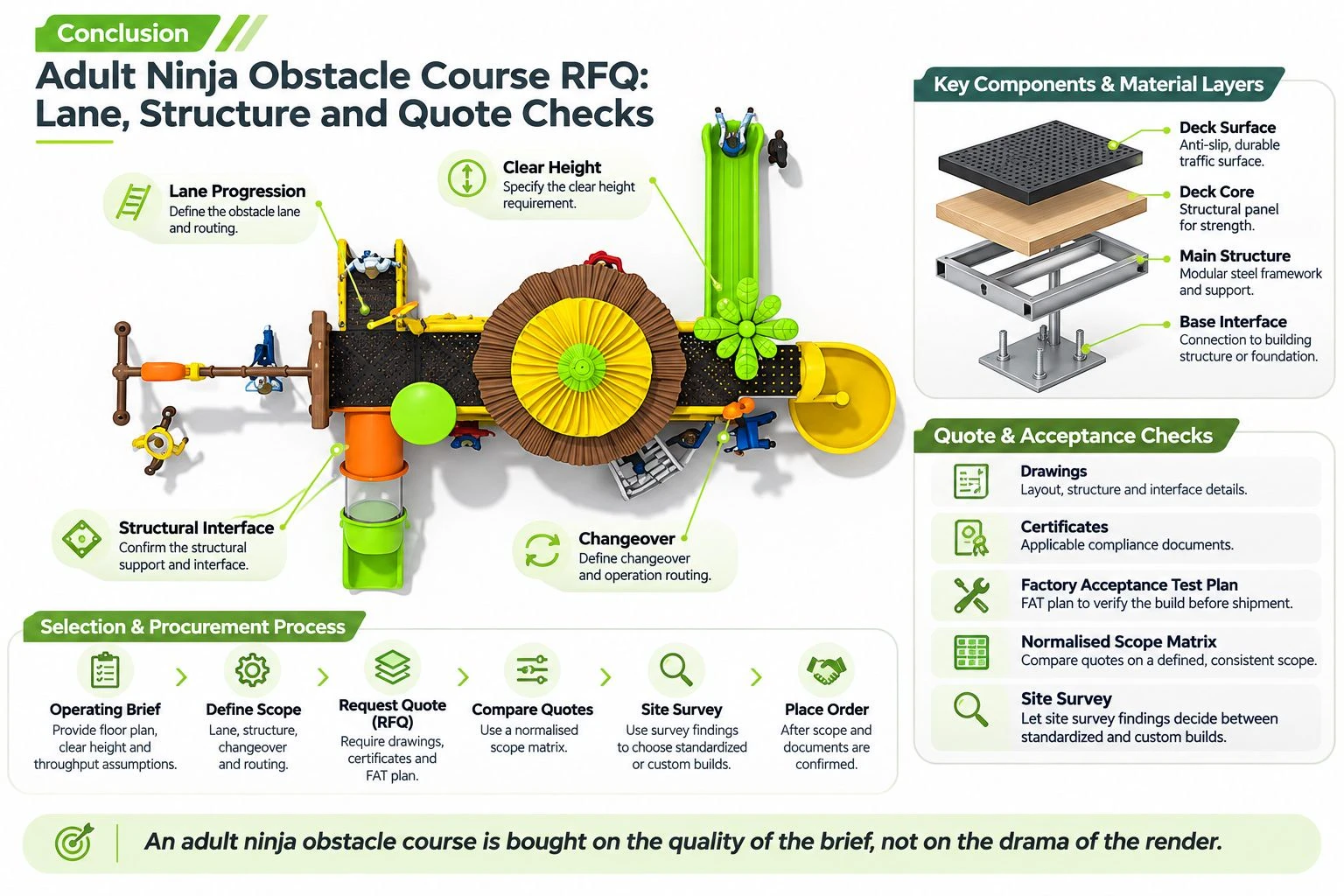
An adult ninja obstacle course is bought on the quality of the brief, not on the drama of the render. Specify clear height, structural interface, lane progression, changeover and routing, then require drawings, certificates and a factory acceptance test plan as conditions of order. Compare quotes on a normalised scope matrix, and let site survey findings, not supplier enthusiasm, decide between standardized and custom builds.
If you are planning your first adult ninja zone, send Dream Garden your floor plan and operating brief, including clear height, throughput assumptions and required documents, so the reply can be priced against a defined scope. You can also review the indoor playground equipment guides and articles for related planning topics before you issue the RFQ.
References & Sources
- Standards & Research - International Adventure & Trampoline Park Association — International Adventure & Trampoline Park Association (indooradventureparks.org)
- Conditions of licence - Public entertainment licence - South Lanarkshire Council — southlanarkshire.gov.uk