
How do you turn handover documents into a component register?
A component register is a single table that maps every obstacle to its approved parts, inspection points and escalation owner. I build it from the as-built drawings first, because the drawing is the only document that shows what was actually installed rather than what was quoted.
The register should carry, as a minimum:
- Zone ID and obstacle ID, matching the drawing labels.
- Approved part name and revision number from the authorised parts list.
- The inspection point (for example, a grip fixing or a pad anchor).
- The responsible person by role, not just a name.
- The escalation path if a defect is found.
Here is a hypothetical example of one row, not a specification for your venue:
| Zone ID | Obstacle ID | Approved part and revision | Inspection point | Responsible role | Escalation path |
|---|---|---|---|---|---|
| Z1 | OB-03 | Grip sleeve, rev. B | Grip fixing and sleeve wear | Lane supervisor | Operations lead → supplier technical contact |
I would not accept a register that lists generic parts. If the parts list does not state a revision, ask the supplier to confirm which revision was supplied, because a later substitution can invalidate the manual's instructions. The handover page from Dream Garden notes that equipment-specific instructions supplied with the project take precedence over general guidance, which is the correct hierarchy.
Which spare parts belong on site, and how do you plan lead times?
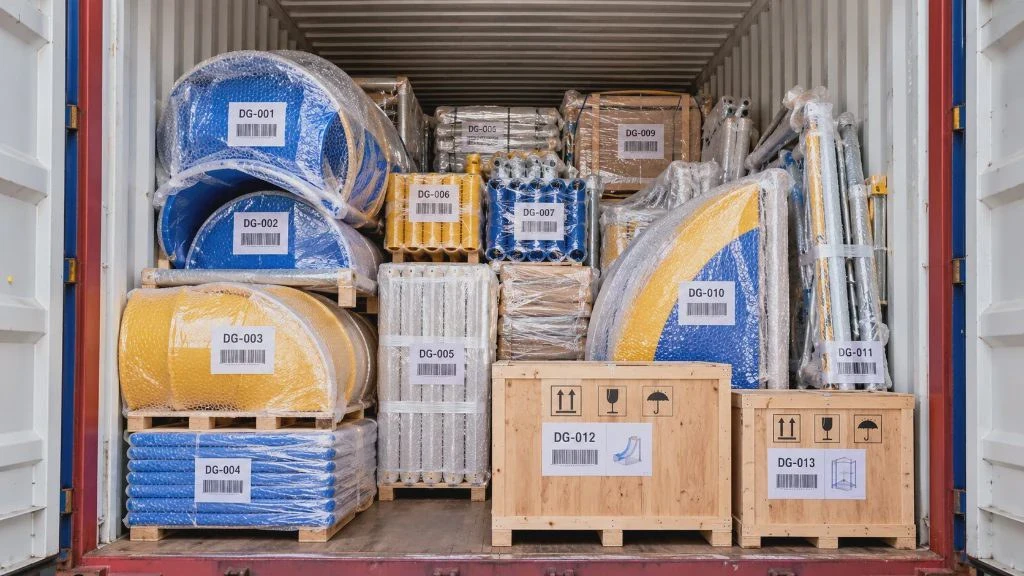
On-site safety stock should cover wear items that can take a lane out of service, and nothing more speculative. I would ask the supplier to identify, from the authorised parts list, the components most likely to wear under adult duty cycles, then hold a small buffer of those items only.
A practical split looks like this:
- Hold on site: wear items that are quick to replace and whose absence would close a lane, such as grip sleeves or pad fastenings listed as authorised parts.
- Order on failure: structural or low-wear components that should only be replaced after supplier guidance.
- Never substitute: fasteners, anchors or load-bearing parts not on the authorised list.
Lead-time planning matters because an adult venue cannot improvise. I would record, for each stocked part, the supplier's stated lead time and the reorder trigger. If a part has a long lead time, the honest answer may be to hold one spare and accept the storage cost, or to plan a scheduled closure rather than an emergency one.
This is where the RFQ discipline pays off later. The adult ninja obstacle course RFQ checklist recommends treating the RFQ as a design brief plus a document checklist and rejecting replies that do not answer both. The same logic applies to spares: ask for the parts list and lead times in writing before you need them.
How should inspection intervals scale under high-duty schedules?
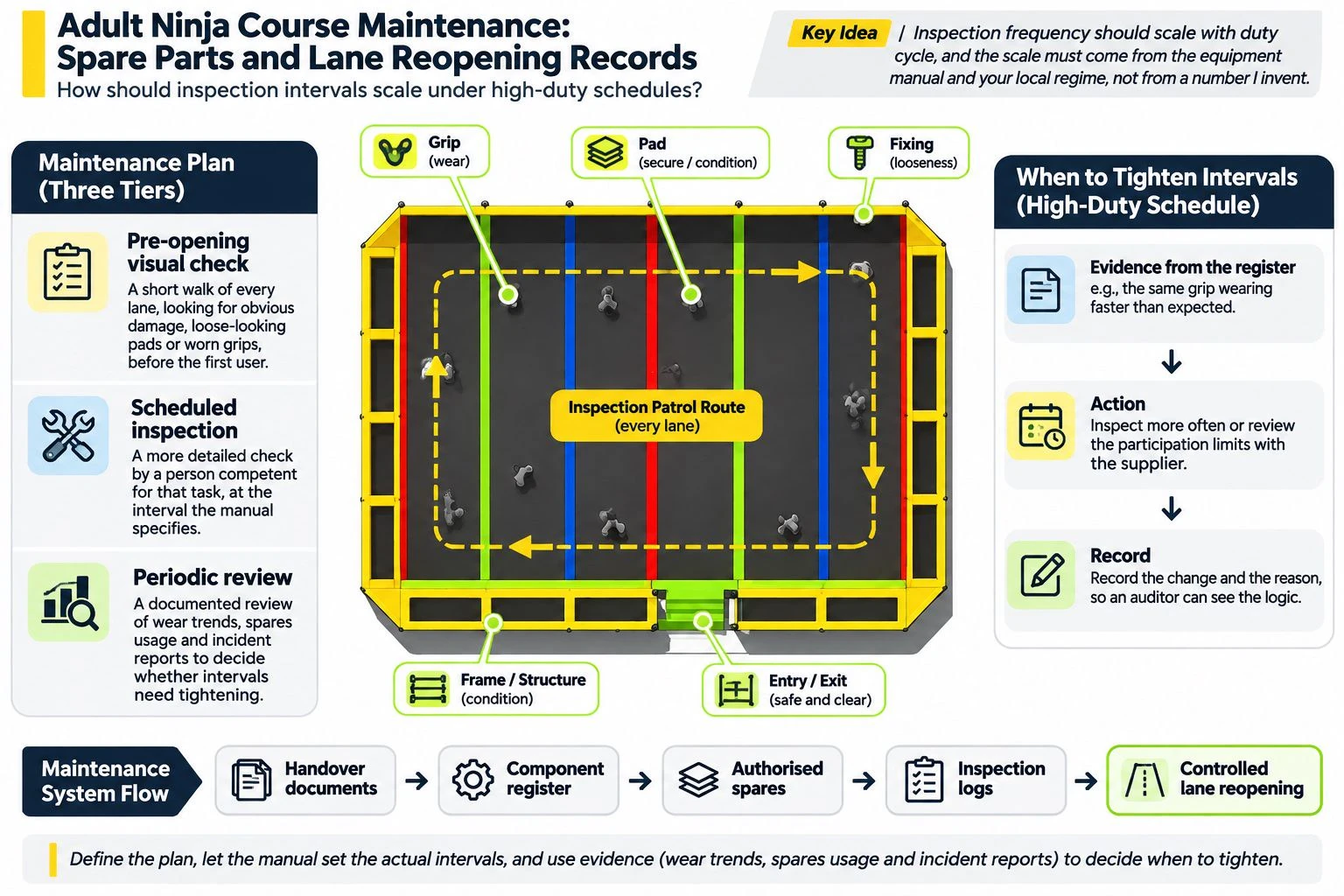
Inspection frequency should scale with duty cycle, but the scale must come from the equipment manual and your local regime, not from a number I invent. What I can tell you is how to structure the decision.
I would define three tiers in the maintenance plan, then let the manual set the actual intervals:
- Pre-opening visual check: a short walk of every lane, looking for obvious damage, loose-looking pads or worn grips, before the first user.
- Scheduled inspection: a more detailed check by a person competent for that task, at the interval the manual specifies.
- Periodic review: a documented review of wear trends, spares usage and incident reports to decide whether intervals need tightening.
Under a high-duty schedule, the trigger for tightening is evidence, not guesswork. If the register shows the same grip wearing faster than expected, that is a signal to inspect more often or review the participation limits with the supplier. I would record the change and the reason, so an auditor can see the logic.
For challenge-course systems, the Association for Challenge Course Technology describes itself as a standards developer and educator for the challenge-course industry, covering design, inspection, operation and training topics. Its ACCT about page[1] is a reasonable starting reference for applicable challenge-course systems, but its scope should not be assumed to cover every floor-level ninja lane. For harnessed aerial attractions, the ASTM aerial adventure course practice listed in the ANSI catalog[2] may be relevant, but I would not assume it applies to a floor-level obstacle lane without checking the equipment scope.
What belongs in inspection logs and torque records for audits?
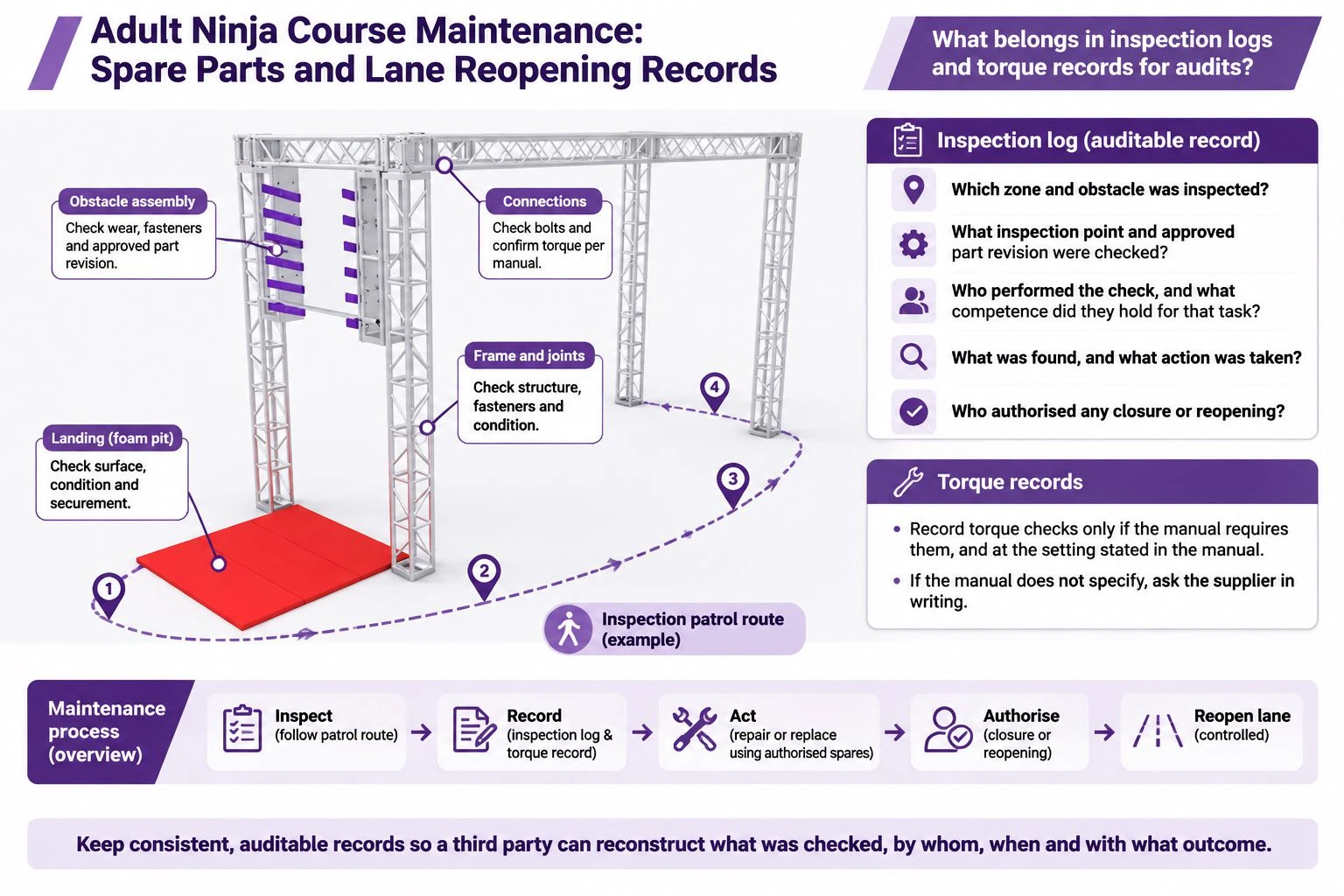
Auditable maintenance records should let a third party reconstruct what was checked, by whom, when and with what outcome. For an adult ninja course, that means inspection logs and any torque records the manual requires, kept in a consistent format.
I would make each log entry answer these questions:
- Which zone and obstacle was inspected?
- What inspection point and approved part revision were checked?
- Who performed the check, and what competence did they hold for that task?
- What was found, and what action was taken?
- Who authorised any closure or reopening?
Dream Garden's playground safety compliance checklist includes an audit sign-off block with fields for inspected by, date of inspection and supplier or manufacturer, which is a useful model for the sign-off line at the end of each record. I would not treat a general checklist as a substitute for the equipment-specific manual, but it is a sensible structure for the audit trail.
On torque specifically, I will not prescribe values. The manual should state whether torque checks are required and at what setting; if it does not, ask the supplier in writing. Recording a torque value that came from a forum or a generic table is worse than recording that no torque check was specified.
How do you control a lane closure and authorised reopening?
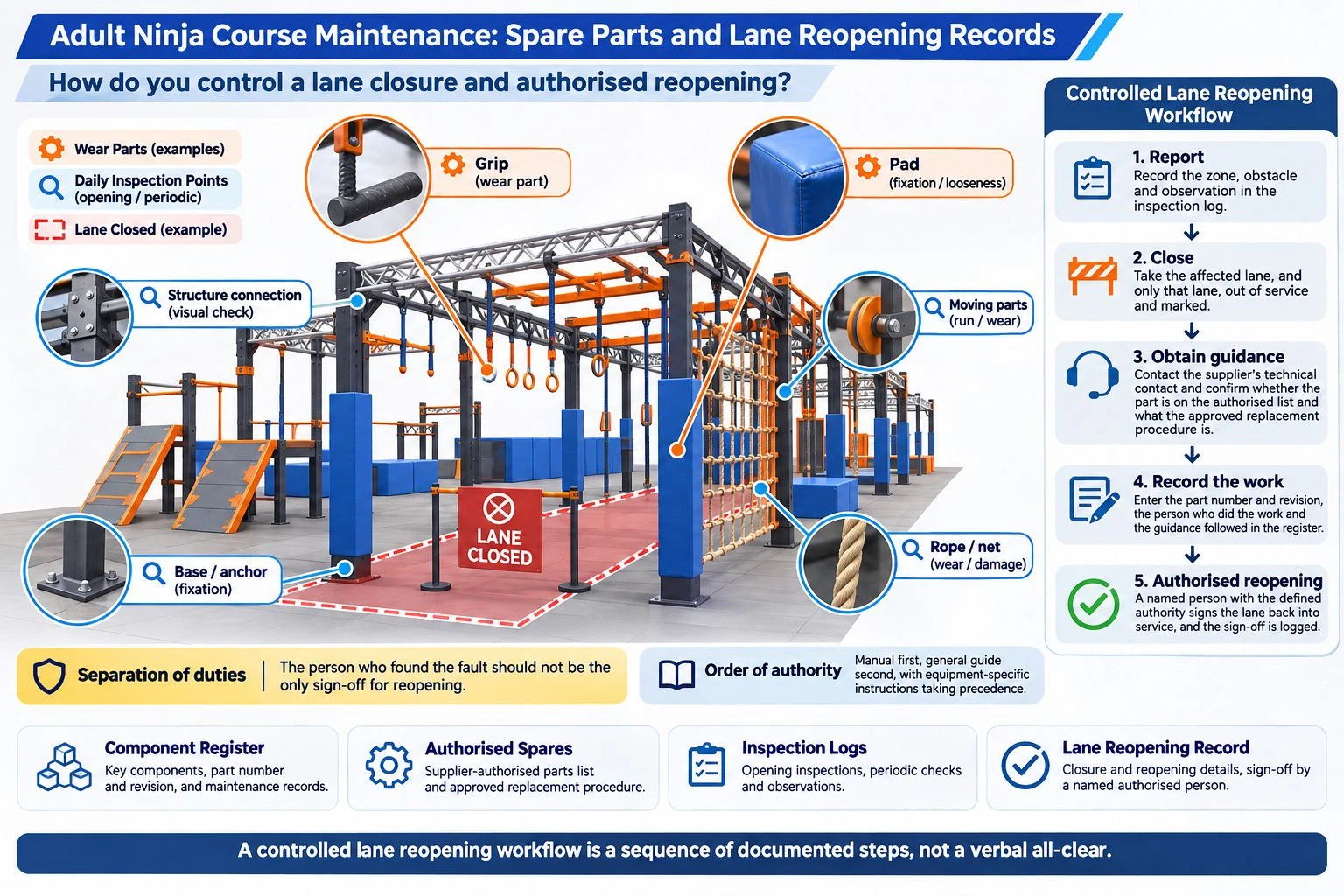
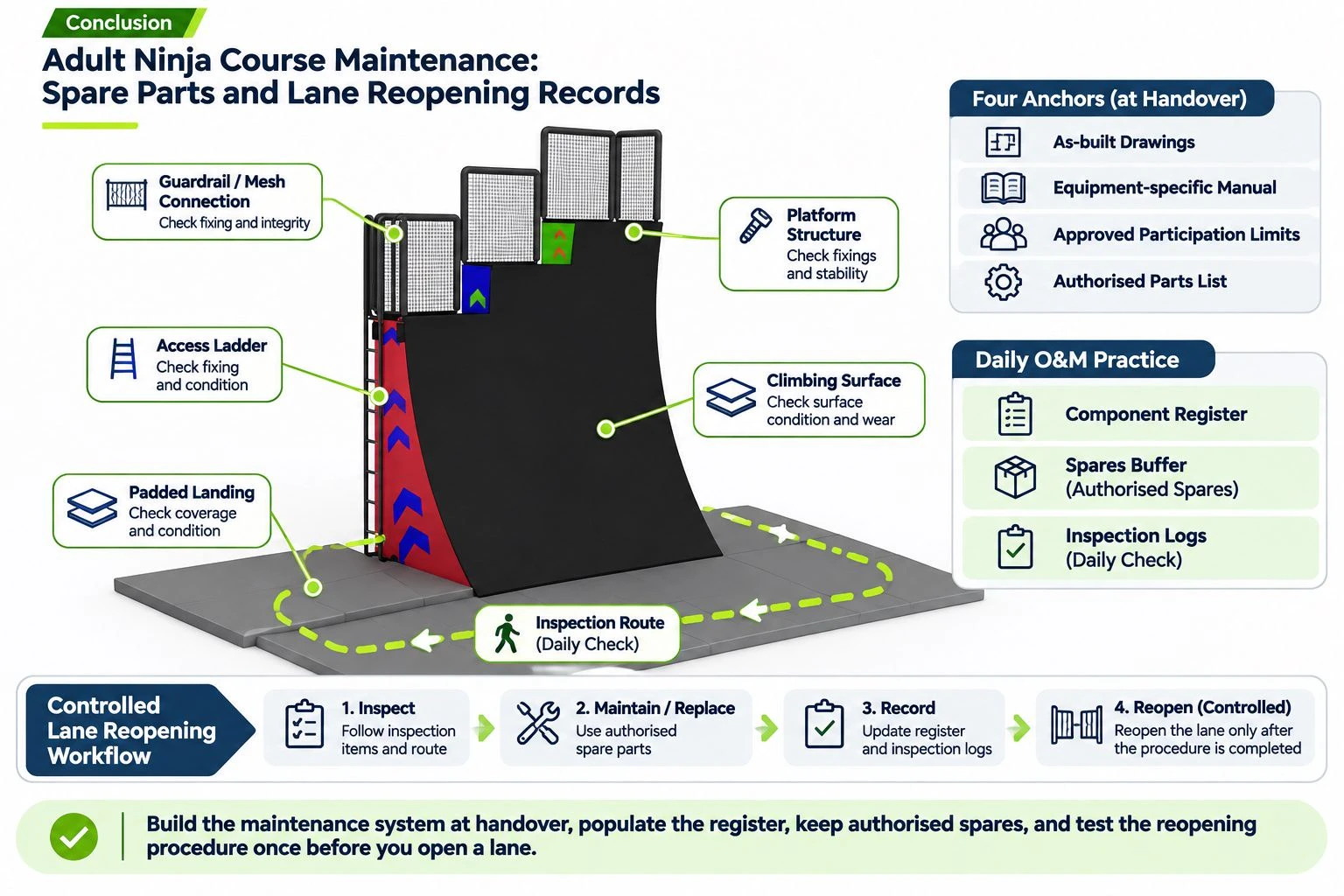
A controlled lane reopening workflow is a sequence of documented steps, not a verbal all-clear. I would test it against a realistic scenario before trusting it.
Hypothetical example: a lane supervisor notices a worn grip and a pad that looks loose during the pre-opening visual check. The correct sequence is:
- Report: the supervisor records the zone, obstacle and observation in the inspection log.
- Close: the affected lane, and only that lane, is taken out of service and marked.
- Obtain guidance: the operations lead contacts the supplier's technical contact and confirms whether the part is on the authorised list and what the approved replacement procedure is.
- Record the work: the part number and revision, the person who did the work and the guidance followed are entered in the register.
- Authorised reopening: a named person with the defined authority signs the lane back into service, and the sign-off is logged.
I would not let the same person who found the fault be the only sign-off for reopening. Separation of duties is a cheap control that makes the record credible. Dream Garden's handover and lifetime support page notes that maintenance and care guides should use opening inspections, periodic checks and surface-care notes, with equipment-specific instructions taking precedence. That is the right order of authority: manual first, general guide second.
Handover checklist for an adult ninja course
A concise handover checklist keeps the maintenance system from drifting after installation. I would confirm each item in writing before the first paid session.
- As-built drawings received and matched to installed obstacles.
- Equipment-specific manual and addenda filed and accessible to the maintenance team.
- Written adult participation limits displayed and briefed to staff.
- Authorised replacement-parts list with revisions and lead times recorded.
- Component register completed with zone, obstacle, part, inspection point, responsible role and escalation path.
- Inspection log template and sign-off block in use.
- Spares buffer for identified wear items stocked and reorder triggers set.
- Lane closure and authorised reopening procedure tested with a drill.
- Supplier technical contact and escalation route confirmed.
If you are still specifying equipment, the commercial playground equipment catalog and the commercial outdoor playground equipment range give a sense of component types, while the commercial soft play equipment pages are useful for padding and soft components. Use them for orientation, not as a substitute for the as-built pack.

Frequently asked questions
Can I use a generic maintenance schedule instead of the supplier manual?
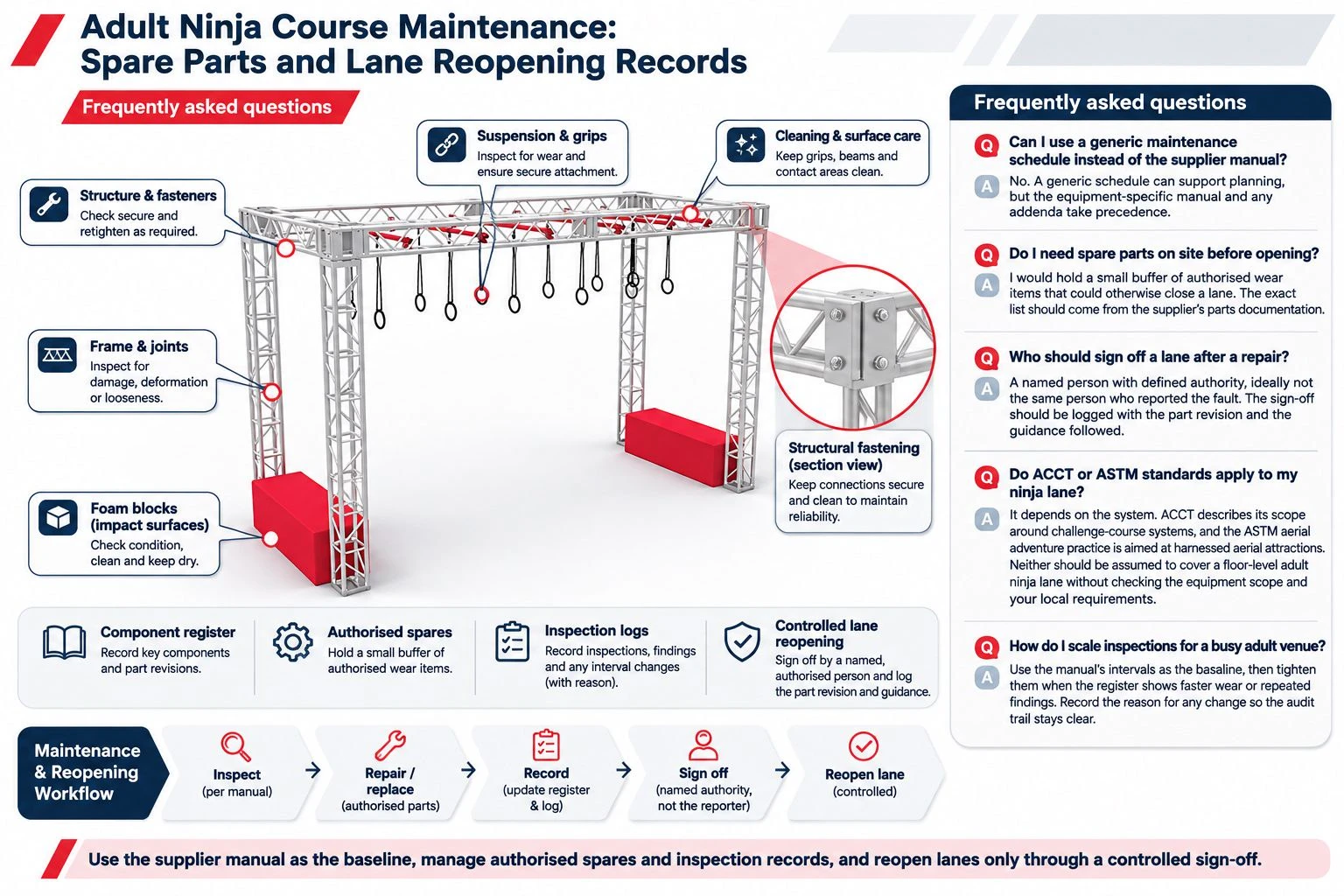
No. A generic schedule can support planning, but the equipment-specific manual and any addenda take precedence. Where the manual is silent, ask the supplier in writing rather than filling the gap with an assumption.
Do I need spare parts on site before opening?
I would hold a small buffer of authorised wear items that could otherwise close a lane. The exact list should come from the supplier's parts documentation, not from a generic kit.
Who should sign off a lane after a repair?
A named person with defined authority, ideally not the same person who reported the fault. The sign-off should be logged with the part revision and the guidance followed.
Do ACCT or ASTM standards apply to my ninja lane?
It depends on the system. ACCT describes its scope around challenge-course systems, and the ASTM aerial adventure practice is aimed at harnessed aerial attractions. Neither should be assumed to cover a floor-level adult ninja lane without checking the equipment scope and your local requirements.
How do I scale inspections for a busy adult venue?
Use the manual's intervals as the baseline, then tighten them when the register shows faster wear or repeated findings. Record the reason for any change so the audit trail stays clear.
Conclusion
The maintenance system for an adult ninja course is built at handover, not after the first failure. As-built drawings, the equipment-specific manual, approved participation limits and an authorised parts list give you the four anchors; the component register, spares buffer and controlled reopening workflow turn them into daily practice.
My recommendation to an operations lead is to refuse to open a lane until the register is populated and the reopening procedure has been tested once. That single discipline is what separates a venue that can demonstrate control from one that is improvising.
References & Sources
- About - ACCT International — acctinfo.org
- This website uses cookies — webstore.ansi.org