







Please contact us!
En

Over the last decade, the indoor playground industry largely grew through children-focused formats: soft play, ball pits, standard tube slides, and toddler zones. That model still matters, but it is no longer enough to win in modern commercial environments.
Today, the winning venues are increasingly those that operate as Family Entertainment Centers (FECs)—multi-attraction indoor destinations designed for all ages, including teenagers and adults. IAAPA defines FECs as venues offering diverse entertainment experiences that serve broad demographics and multiple visit purposes (family recreation, parties, group events, and more). IAAPA.org
The business logic is clear: all-ages entertainment increases visit frequency, expands peak-hour utilization, and improves revenue per square meter by supporting layered products (tickets, parties, food & beverage, memberships, and premium experiences).
When we say “adult indoor playground,” we are not talking about childish equipment made bigger. We are talking about a new experience language built around:
competition and performance (race, time challenge, scoreboard culture),
social play (friends, couples, teens, groups),
visual icon attractions (content-friendly spaces that people want to film and share),
low-barrier thrill (high excitement without extreme risk).
This is exactly why “all-ages” slide parks and action parks are expanding. A good reference is Slick City Action Park, which positions its experience around indoor dry slides and attractions “for all ages,” demonstrating that slides can be a primary driver—rather than a supporting feature. References:
In next-generation FEC design, the Competitive Slide Attraction is emerging as one of the most representative “anchor attractions.” It works because it is both:
instantly understandable (no learning cost—everyone knows how to slide),
instantly social (race friends, challenge family, watch others),
instantly visual (a big slide cluster becomes the venue’s signature image),
instantly scalable (you can expand from 2 lanes to 6+ lanes, add different slide types, build a full slide zone).
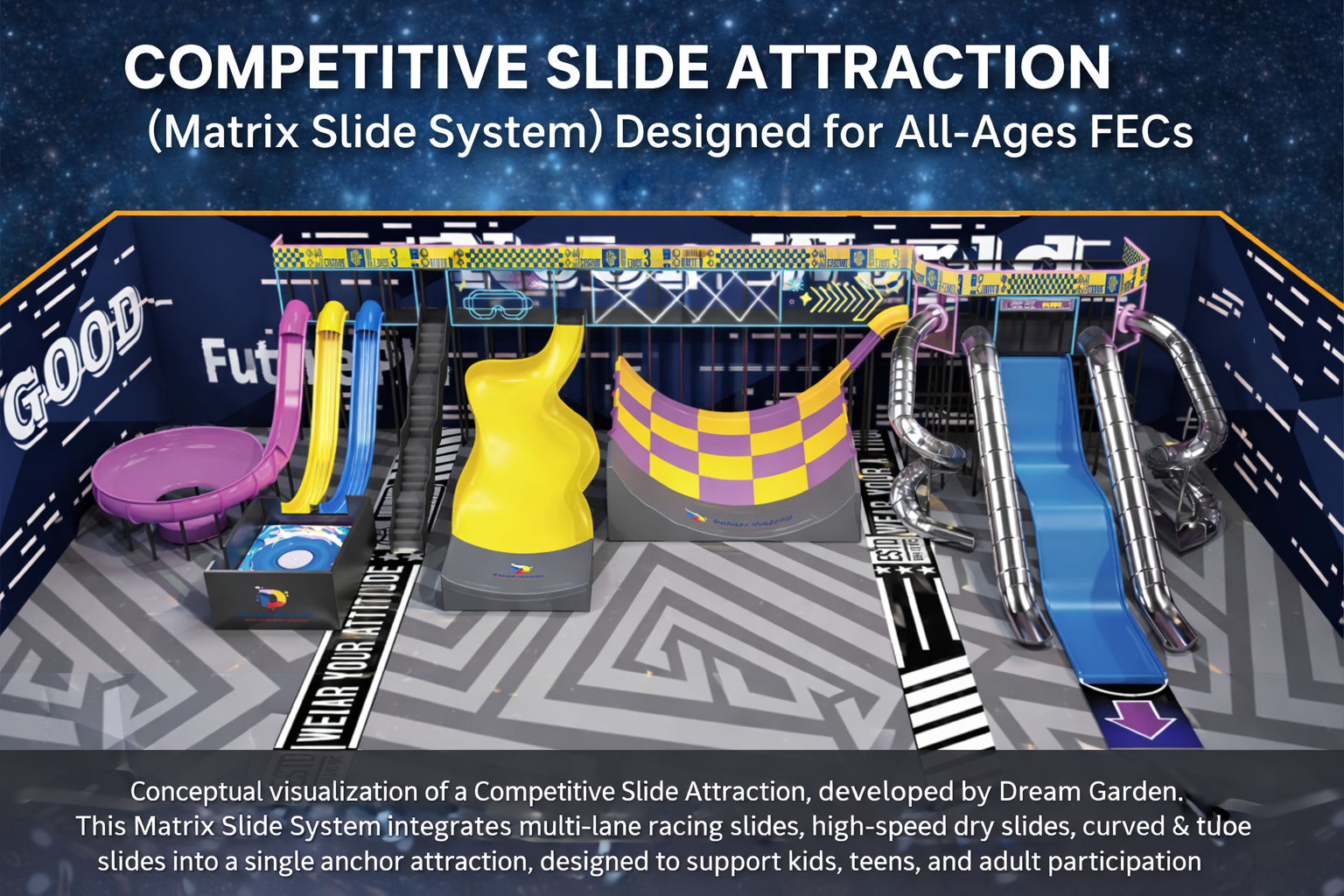
In practice, many operators and suppliers describe this as a Matrix Slide System—a slide cluster that combines multiple slide experiences in one integrated attraction:
Multi-lane racing slides
High-speed straight slides (“dry slides”)
Spiral / tube slides
Drop-style slides
Group flow + queue design that increases throughput
This slide-driven competition changes the commercial role of slides:
Slides are no longer a “children’s add-on.” They are increasingly designed as a core revenue-generating experience—especially when packaged with time-based tickets, premium lanes, party upgrades, and photo/video moments.
The macro environment supports this shift. Independent market research indicates strong growth for indoor amusement formats. For example, Grand View Research estimates the global indoor amusement center market at USD 51.29B (2024) and projects USD 84.03B by 2030, with ~9% CAGR. Grand View Research
(Reference: https://www.grandviewresearch.com/industry-analysis/indoor-amusement-center-market-report)
At the same time, the global attractions industry is stabilizing into renewed growth cycles. TEA’s Global Experience Index reporting highlights ongoing growth and recovery patterns across major themed entertainment markets. 茶关联
(Reference: https://www.teaconnect.org/news/official-release-2024-tea-global-experience-indextm)
And importantly: global investment is shifting toward regions that need indoor, climate-resilient entertainment formats—especially the Middle East.
In our recent Dream Garden industry analysis, we highlighted how global entertainment giants are accelerating expansion into the Middle East, where mega-projects and mixed-use developments require year-round indoor experiences. Toy Maker in China+1
Universal Studios is reported to be in early planning for a potential theme park in Saudi Arabia (WSJ / Reuters coverage). 华尔街日报+1
The strategic meaning is bigger than one project: the region is building entertainment ecosystems where indoor attractions are mandatory due to climate, dwell-time economics, and integrated destination planning.
This is why our conclusion remains consistent across both Dream Garden articles:
The future of indoor playground equipment is moving from “equipment supply” to “experience infrastructure.” Toy Maker in China
Entertainment investment in the Middle East is raising standards for localization, durability, and long-term performance. Toy Maker in China
Your two reference posts (for internal linking on your site):
https://www.toymakerinchina.com/news-show/the-future-of-indoor-playground-equipment.html Toy Maker in China
https://www.toymakerinchina.com/news-show/entertainment-giants-accelerate-expansion-into-the-middle-east.html Toy Maker in China
As CEO of Dream Garden, my view is that the industry is entering a phase where operators must design for teen energy + adult participation, not just child safety.
That means:
Attractions must be competitive
Teenagers don’t pay for “cute.” They pay for challenge, progression, and social status.
Experiences must be shareable
If an attraction does not create content, it loses to the ones that do.
Throughput and durability become strategic
High-footfall zones need long-life engineering, fast maintenance, and stable operations.
Design is now a market-entry tool
Localization (culture + color language + theme storytelling) decides whether a venue becomes “the place” in a city.
Competitive Slide Attractions deliver on all four—when designed correctly.
Dream Garden’s global strategy is built around one core goal:
Help developers and operators create all-ages indoor entertainment that is localized, durable, and commercially scalable.
To do that, we focus on three pillars:
(1) Customized experience design
We don’t sell “standard slides.” We build attraction narratives: racing lanes, spotlight zones, queue storytelling, photo moments, and zoning logic for kids/teens/adults.
(2) Durability and lifecycle performance
All-ages attractions increase load intensity. That means structural engineering, surface material choices, and maintenance planning must be upgraded accordingly.
(3) Global delivery and localization
From Southeast Asia to the Middle East and beyond, we adapt design to:
climate realities (indoor, ventilation, material performance),
cultural preferences (theme language, colors, behaviors),
operational models (ticketing, parties, group bookings).
The future of FECs is not a bigger kids playground. It is a more intelligent entertainment system—built for families, teens, and adults together.
And among all attraction formats now rising globally, Competitive Slide Attractions—often delivered as a Matrix Slide System—stand out as one of the clearest signals of where the industry is going:
high participation,
high visual impact,
high repeatability,
strong commercial scalability.
For Dream Garden, this is not just a product direction—it is a global vision:
From “play equipment” to “experience infrastructure,” from “kids-only” to “all-ages entertainment,” and from “local supply” to “global expansion-ready solutions.”
Copyright Wenzhou Dream Garden Amusement Equipment Co.,Ltd | Sitemaps|Xml
| AK 60175900 |
  |
|  |
|  |
|  | Blooloop | TEA | Hague Apostille Certification| Crunchbase | Featured in Vanguard
Please contact us!