







Please contact us!
En

As global entertainment investment accelerates—particularly in the Middle East, Southeast Asia, and emerging urban markets—indoor playground equipment is undergoing a strategic repositioning.
Once viewed primarily as supplementary facilities, indoor playgrounds are increasingly designed as core, revenue-generating attractions within shopping malls, family entertainment centers (FECs), mixed-use developments, and even large-scale theme park destinations.
This shift is closely aligned with broader changes in how entertainment spaces are financed, designed, and operated worldwide.
Industry research published by Themed Entertainment Association (TEA) and AECOM indicates that the global attractions sector continues to recover and expand, with emerging regions playing a central role in future growth.
Within this landscape, the indoor playground and FEC segment is outperforming many traditional outdoor-only formats. Market analysts estimate that indoor entertainment formats—including soft play, interactive zones, and hybrid indoor attractions—are growing at an annual rate of approximately 8–10%, driven by:
Climate resilience, particularly in hot or extreme-weather regions such as the Middle East
Urban density, where indoor entertainment integrates seamlessly into commercial real estate
Operational stability, offering year-round revenue without seasonal limitations
Repeat-visit potential, supported by modular and upgradable designs
As a result, indoor playgrounds are increasingly treated as long-term infrastructure assets, not short-cycle entertainment installations.
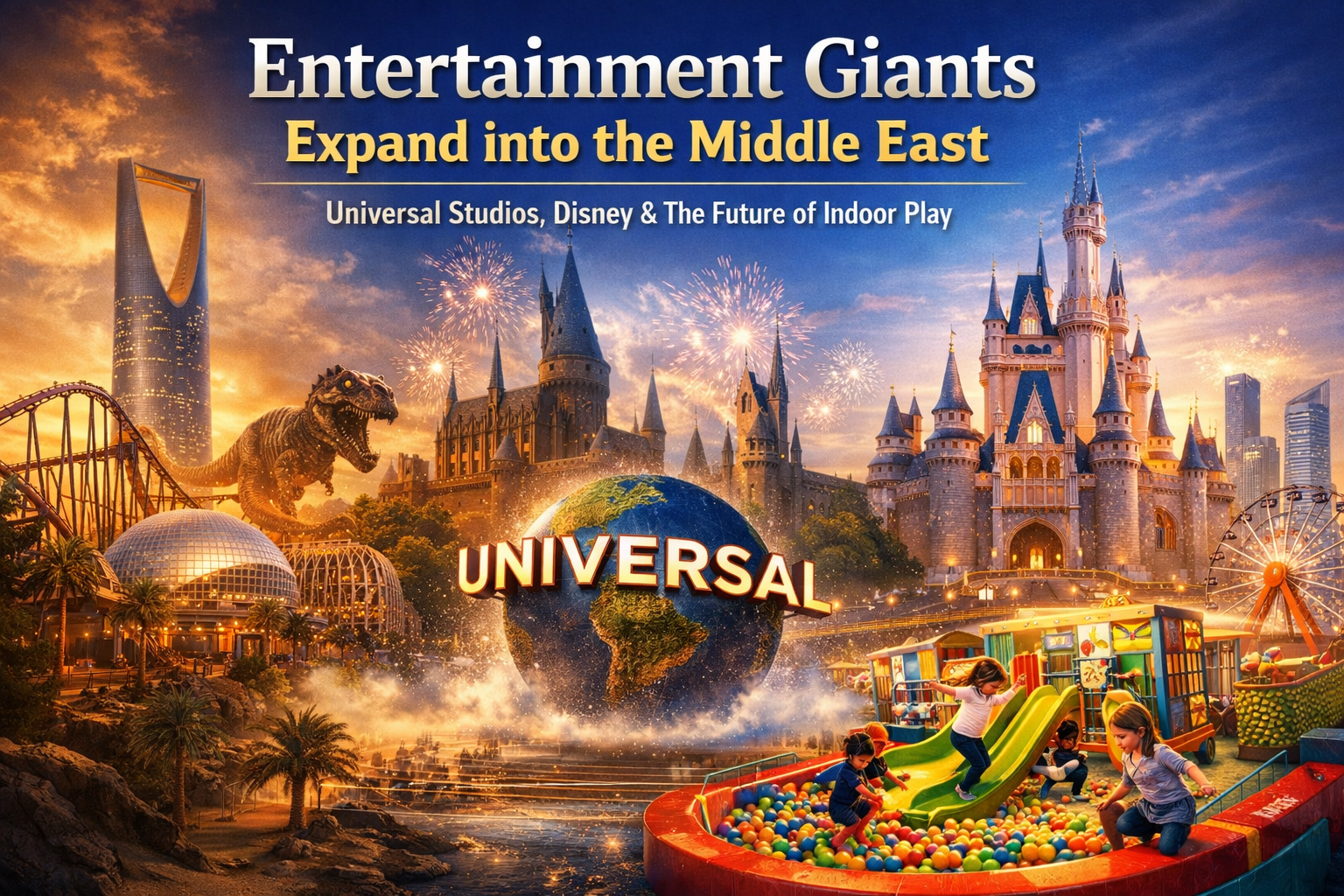
Recent announcements involving Universal Studios and The Walt Disney Company highlight how indoor and climate-controlled attractions are becoming integral components of large-scale destination projects.
According to The Wall Street Journal, Universal Studios is in early-stage planning for a potential theme park in Saudi Arabia, while Disney has confirmed its first Middle East resort in Abu Dhabi. These projects reflect a broader trend: entertainment investment is moving toward regions where indoor experiences are essential for year-round operation.
For developers and operators, this further elevates the strategic value of high-quality indoor playground solutions.
From the perspective of Dream Garden, a China-based manufacturer and solution provider with over 15 years of experience in indoor playground and themed entertainment projects, the industry is moving away from standardized equipment toward project-specific systems.
Key changes include:
Customization over standardization – designs tailored to local culture, branding, and spatial constraints
Higher durability requirements – materials and structures engineered for long operating cycles and high foot traffic
Integrated safety and compliance – alignment with international standards from the earliest design stage
Adaptability and modularity – enabling future upgrades without full replacement
These shifts reflect a growing focus on lifecycle value, rather than initial installation cost alone.
Stefan Zhang, CEO of Dream Garden, offers a forward-looking assessment of where the indoor playground equipment industry is heading:
“Indoor playgrounds are no longer designed as secondary amenities. They are increasingly planned as core experiences that directly influence dwell time, repeat visits, and overall commercial performance.
Over the next decade, the success of indoor playground equipment will depend on three critical factors: customization, durability, and adaptability. Operators want environments that reflect local identity, perform reliably under intensive use, and evolve as audience expectations change.
From a manufacturing perspective, this requires a shift away from one-size-fits-all products toward integrated solutions, where design, engineering, safety, and long-term maintenance are considered as a unified system.”
Looking ahead, several structural forces are expected to support continued growth in indoor play:
Expansion of mixed-use developments, where entertainment drives commercial footfall
Rising expectations from parents and families, prioritizing safety, design quality, and educational value
Greater emphasis on climate-controlled environments, particularly in high-temperature regions
Investment from global entertainment brands, raising standards across the supply chain
Together, these factors position indoor playground equipment as one of the most resilient and scalable segments within the global attractions industry.
The future of indoor playground equipment lies not in volume production, but in experience-driven design and long-term performance.
As global entertainment investment continues to shift toward emerging regions and integrated developments, indoor playgrounds will play an increasingly strategic role—serving not just as play areas, but as foundational components of modern entertainment ecosystems.
Related insight:
Entertainment Giants Accelerate Expansion into the Middle East
Indoor playground equipment is evolving from a supplementary facility into a core asset within global entertainment developments. Industry data from TEA and AECOM shows indoor entertainment formats growing at an estimated 8–10% annually, driven by climate resilience, urbanization, and repeat-visit demand. As major brands such as Universal Studios and Disney expand into regions like the Middle East, indoor play is becoming essential for year-round operation. From a manufacturing perspective, Dream Garden and its CEO Stefan Zhang emphasize that the future of indoor playground equipment will be defined by customization, durability, and adaptability rather than scale alone.
Copyright Wenzhou Dream Garden Amusement Equipment Co.,Ltd | Sitemaps|Xml
| AK 60175900 |
  |
|  |
|  |
|  | Blooloop | TEA | Hague Apostille Certification| Crunchbase | Featured in Vanguard
Please contact us!