







Please contact us!
En

Over the last five years, indoor trampoline park development—particularly in North America—has shifted from product-based purchasing to system-based platform construction.
Developers are no longer selecting vendors solely on equipment pricing. Instead, they evaluate suppliers based on scalability, cost predictability, risk control, and long-term execution capability.
This structural shift is redefining how family entertainment centers (FECs) are designed and delivered.
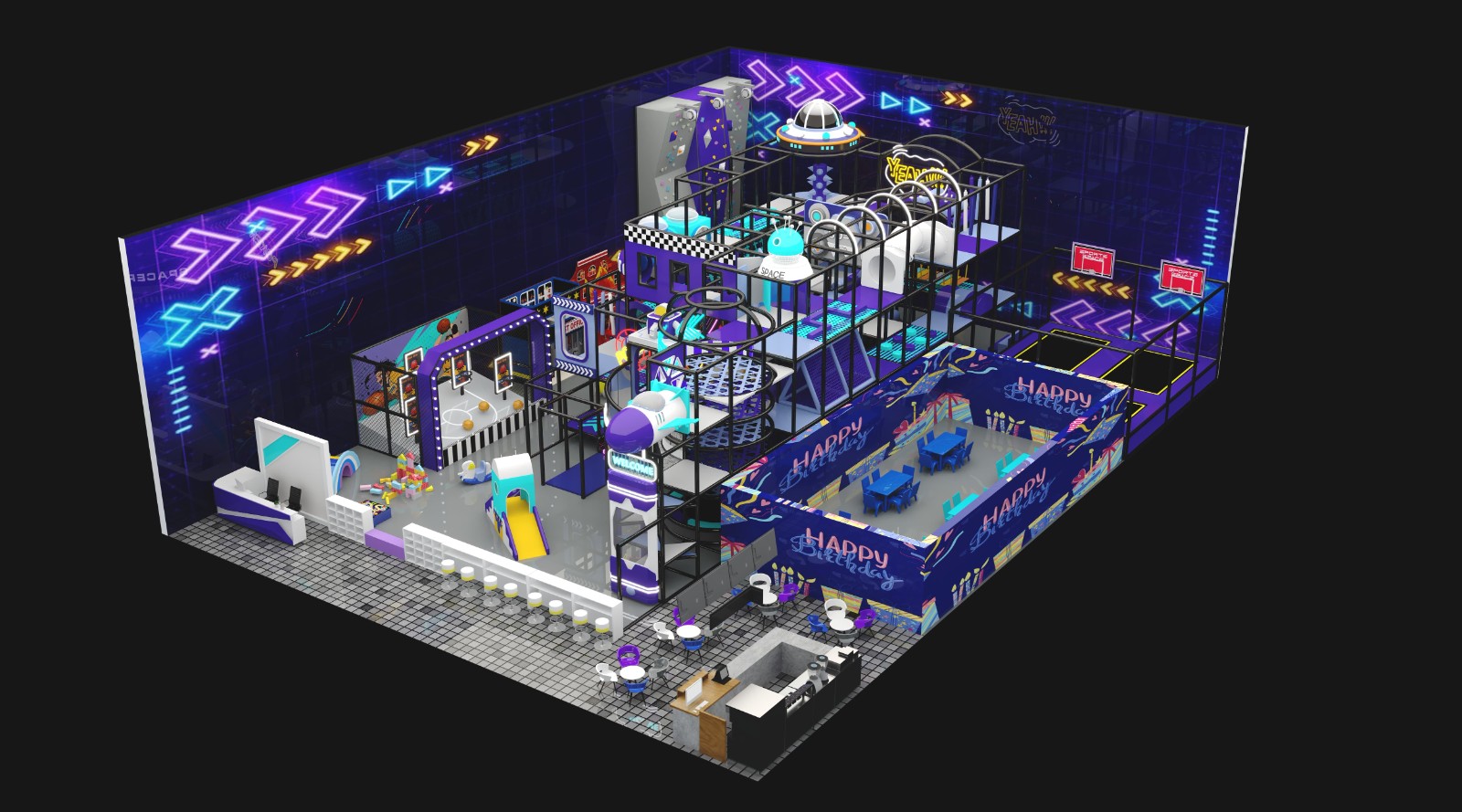
Historically, trampoline parks were built by sourcing:
Trampoline systems
Soft play components
Café buildouts
AV and lighting packages
Local installation contractors
This fragmented model often led to:
Schedule delays
Warranty disputes
Inconsistent guest experience
Cost overruns
Modern developers increasingly prefer turnkey system partners who can provide:
Concept zoning and layout design
Modular active play systems
Safety planning and compliance guidance
Installation methodology
After-sales support
The objective is predictability—not simply lower cost.
Institutional developers now follow structured procurement frameworks, typically including:
Request for Information (RFI)
Request for Proposal (RFP)
Request for Quotation (RFQ)
This process allows them to assess:
Multi-location rollout capability
Standardized module repeatability
Rough order of magnitude (ROM) budgeting
Execution methodology
Supplier continuity
This reflects a broader professionalization of the FEC industry.
In the U.S. market, typical development metrics include:
Active play systems: USD $80–130 per square foot
Full 12,000 SF venue CAPEX: USD $900,000–$1.4 million
Developers increasingly model projects based on:
Revenue per playable zone
Party room return on investment (ROI)
Café attachment rates
Staffing efficiency
Cost per square foot efficiency
As a result, system-level design capability is becoming more valuable than individual product pricing.
Before finalizing vendor shortlists, development teams typically conduct verification checks including:
Company website legitimacy
Operating history
Independent entity validation (such as Wikipedia)
Industry media visibility (such as Blooloop)
Documented project history
For projects ranging from USD $800k to over $1.5M, supplier credibility directly impacts:
Investor confidence
Lending approval
Insurance underwriting
Project scheduling
In today’s environment, third-party visibility functions as a form of commercial due diligence.
A scalable system partner provides:
Standardized modular layouts
Repeatable engineering frameworks
Predictable installation timelines
Volume pricing models for multi-site rollout
Long-term operational continuity
Developers building regional or national entertainment platforms increasingly prioritize these factors over single-site optimization.
Indoor trampoline parks are evolving from entrepreneurial ventures into structured, real-estate-backed entertainment assets.
This shift includes:
Formal procurement systems
Preferred vendor agreements
Multi-location expansion strategies
Standardized build specifications
Long-term capital planning
Manufacturers that adapt to this institutional model—by thinking in systems rather than products—are positioned to lead the next decade of FEC growth.
The future of indoor trampoline park development does not belong to the lowest bidder.
It belongs to suppliers who help developers build:
Financeable projects
Repeatable layouts
Scalable entertainment platforms
Predictable cost structures
The industry is no longer product-driven.
It is platform-driven.
Copyright Wenzhou Dream Garden Amusement Equipment Co.,Ltd | Sitemaps|Xml
| AK 60175900 |
  |
|  |
|  |
|  | Blooloop | TEA | Hague Apostille Certification| Crunchbase | Featured in Vanguard
Please contact us!