







Please contact us!
En

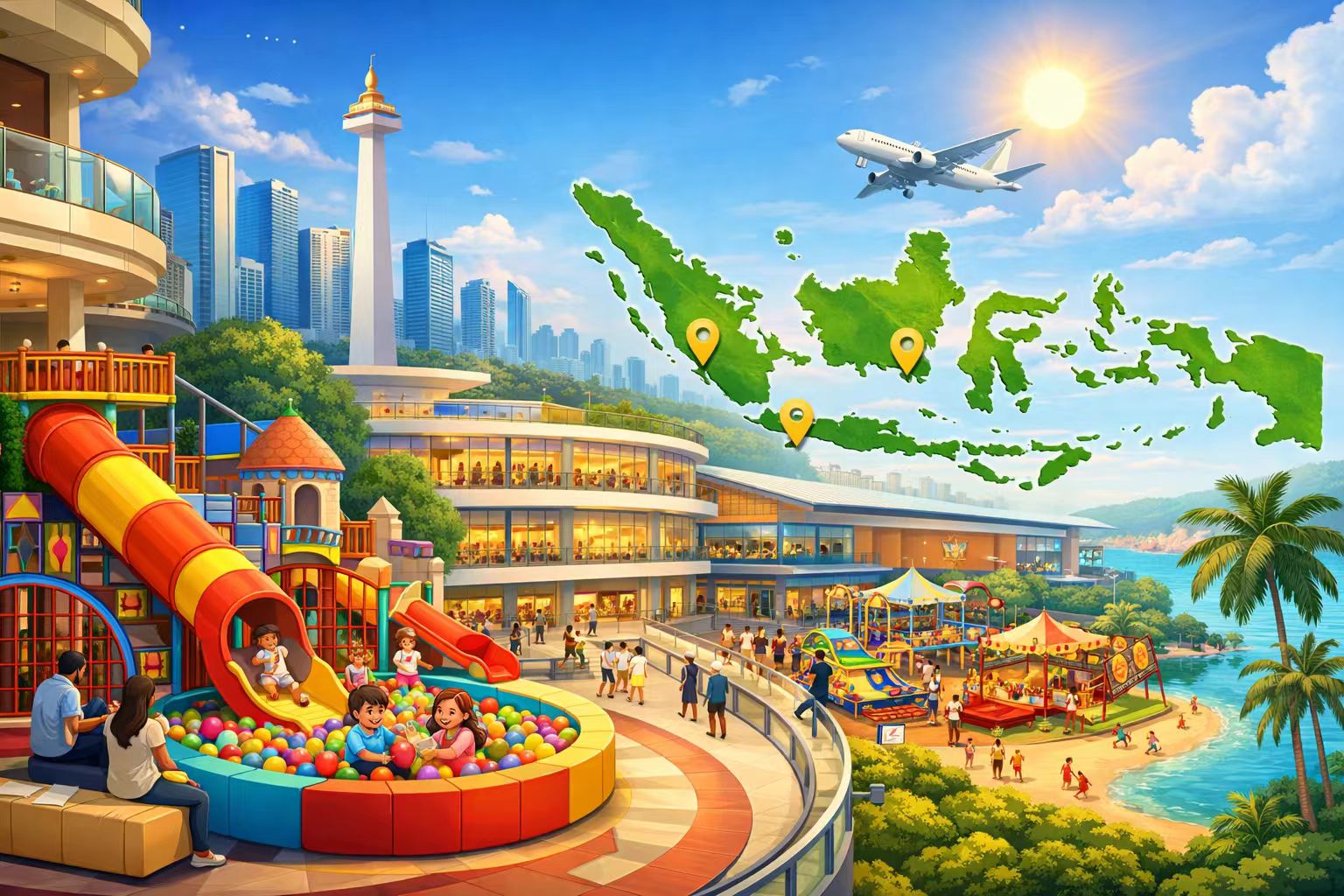
Indonesia is emerging as one of Southeast Asia’s most promising markets for family entertainment and indoor playground development. With a population exceeding 270 million people, a rapidly expanding middle class, and strong urbanization trends, the country offers significant opportunities for retailers, investors, and entertainment operators.
Major retail groups such as
PT Aspirasi Hidup Indonesia
operate extensive store networks across the country. These retail ecosystems are increasingly shifting toward experience-driven retail models, where entertainment plays a critical role in attracting family customers.
One of the fastest-growing concepts within this transformation is the integration of indoor playgrounds and family entertainment centers (FECs) inside retail environments.
Traditional retail stores were primarily focused on product sales. However, the rapid growth of e-commerce platforms such as Tokopedia, Shopee, and Lazada has dramatically changed consumer behavior.
As a result, modern retail operators are transforming their stores into lifestyle destinations that combine shopping, dining, and entertainment.
Key trends include:
experiential retail concepts
family-friendly shopping environments
longer customer dwell time
entertainment-based attractions.
Shopping malls and retail complexes are increasingly integrating:
children's play zones
trampoline parks
interactive entertainment spaces
educational play environments.
These attractions help drive repeat visits and stronger customer engagement.
Several factors make Indonesia a particularly strong market for indoor playground development.
Indonesia has one of the youngest populations in Asia. Families with children represent a significant share of consumer spending.
Shopping malls are central social hubs in major cities such as Jakarta, Surabaya, Bandung, and Medan.
Indoor entertainment is especially attractive due to Indonesia’s warm and humid climate.
New commercial centers and residential developments are increasing demand for family entertainment infrastructure.
Large retail groups have a strategic advantage in launching family entertainment concepts.
Companies operating large retail networks already attract significant family traffic and have access to premium commercial locations.
For example, retail groups like Kawan Lama operate hundreds of stores across dozens of Indonesian cities, creating ideal locations for integrating indoor entertainment spaces.
By converting underutilized store areas into children's play zones, retailers can:
increase foot traffic
extend customer stay time
improve overall store profitability.
Small play areas integrated inside large-format retail stores.
Typical size:
50–200 sqm.
These playgrounds provide short-term entertainment while parents shop.
Indoor playground attractions located within shopping malls.
Typical size:
300–800 sqm.
These venues serve as family destinations and can significantly increase mall foot traffic.
Larger-scale indoor playground facilities.
Typical size:
1000–3000 sqm.
These entertainment centers often include:
multi-level playground structures
climbing challenges
obstacle courses
interactive play zones.
Wenzhou Dream Garden Amusement Equipment Co., Ltd.
is a global manufacturer specializing in custom indoor playground systems and family entertainment center solutions.
The company provides:
customized playground design
manufacturing and engineering
installation guidance
turnkey project solutions.
Dream Garden equipment is widely used in:
shopping malls
family entertainment centers
commercial play spaces
community leisure facilities.
Projects have been implemented in more than 70 countries, supporting investors and developers worldwide.
For retail groups in Indonesia, integrating indoor playground facilities offers multiple operational benefits.
Family attractions encourage repeat visits and attract younger demographics.
Parents tend to stay longer in retail environments where children have dedicated play spaces.
Longer visits increase spending across retail, dining, and entertainment categories.
Family-friendly retail environments create stronger emotional connections with customers.
Indonesia’s indoor playground industry is still in a relatively early stage compared with developed markets in Europe and East Asia.
This presents significant opportunities for:
shopping mall developers
retail chains
family entertainment operators
private investors.
With rising urbanization and increasing family spending, indoor playground facilities are expected to become a standard component of modern retail environments across Indonesia.
Indonesia represents one of the most promising emerging markets for indoor playground development.
As retail environments evolve toward experience-based destinations, the integration of family entertainment facilities will play a key role in attracting visitors and increasing commercial value.
Retail groups, developers, and investors that embrace indoor playground concepts today will be well positioned to capture the growing demand for family-oriented entertainment across Southeast Asia.
Yes. Indonesia’s young population, expanding shopping mall infrastructure, and growing middle class create strong demand for family entertainment centers.
Indoor playgrounds increase customer traffic, extend visit duration, and improve overall retail spending.
Typical playground sizes range from 300 to 1000 square meters, depending on the mall size and target audience.
Yes. Many large-format retail stores now integrate 50–200 sqm children’s play areas to attract families.
Copyright Wenzhou Dream Garden Amusement Equipment Co.,Ltd | Sitemaps|Xml
| AK 60175900 |
  |
|  |
|  |
|  | Blooloop | TEA | Hague Apostille Certification| Crunchbase | Featured in Vanguard
Please contact us!