







Please contact us!
En

Choosing the right building size for your indoor playground project is a crucial decision that impacts both customer satisfaction and return on investment. At Dream Garden, with extensive experience in designing, manufacturing, and installing indoor playground equipment worldwide, we help you consider all the essential factors to make this choice. There’s no one-size-fits-all answer; instead, the ideal building size depends on several aspects, such as budget, target audience, product mix, location, and scale. Here’s a guide based on industry insights to help you assess your needs.
Investment & Revenue Goals
The amount you plan to invest and your revenue expectations play a significant role in determining your facility’s size. Smaller facilities, such as soft play cafes, are generally under 2,000 sq. ft. and cater to specific customer bases. Larger family entertainment centers, however, often exceed 15,000 sq. ft. to accommodate more features and activities, resulting in higher potential earnings.
Product Mix
Defining the types of attractions you want to include will influence space requirements. Here are general guidelines for different setups:
A larger building allows for additional features such as climbing walls, virtual reality (VR), trampolines, ninja courses, and interactive elements. Centers over 5,000 sq. ft. have the flexibility to add role-play zones or themed areas to create a distinctive experience.
Soft Play Café: Up to 2,000 sq. ft.
Children’s Soft Play Center (Ages 0-5): 3,000 - 5,000 sq. ft.
Soft Play Center (Ages 0-7): 5,000 - 7,000 sq. ft.
Children’s Play Center (Ages 0-11): Over 7,000 sq. ft.
Family Entertainment Center (Ages 0-11): Up to 10,000 sq. ft.
All-Age Family Entertainment Center: 15,000 - 40,000 sq. ft. or more.
Age Range & Target Audience
Tailor your facility's size to accommodate your target age range. For instance, if you’re catering to young children (ages 0-5), a 3,000 - 5,000 sq. ft. space may suffice. For broader age groups or family-oriented facilities, 10,000 - 40,000 sq. ft. is ideal to include various attractions and appeal to all ages.
Geographical Location & Competition
Consider the demographics and competition in your location. A facility in a densely populated area may benefit from a larger footprint with diverse attractions to stay competitive. Additionally, regional preferences for certain play styles (like agility courses or sensory rooms) should influence your product and layout choices.
Budget & Capital Expenditure
Your budget will dictate the scope and scale of your facility. Evaluate your capital expenditure, funding sources, and potential return on investment to determine the right scale for your indoor playground. With our assistance at Dream Garden, you can receive guidance on setting realistic goals for equipment and installation costs.
Future Expansion
If you plan to expand over time, selecting a space that accommodates future growth can be a smart move. Many facilities start small and gradually add features, maximizing their initial investments while accommodating increasing visitor demand.
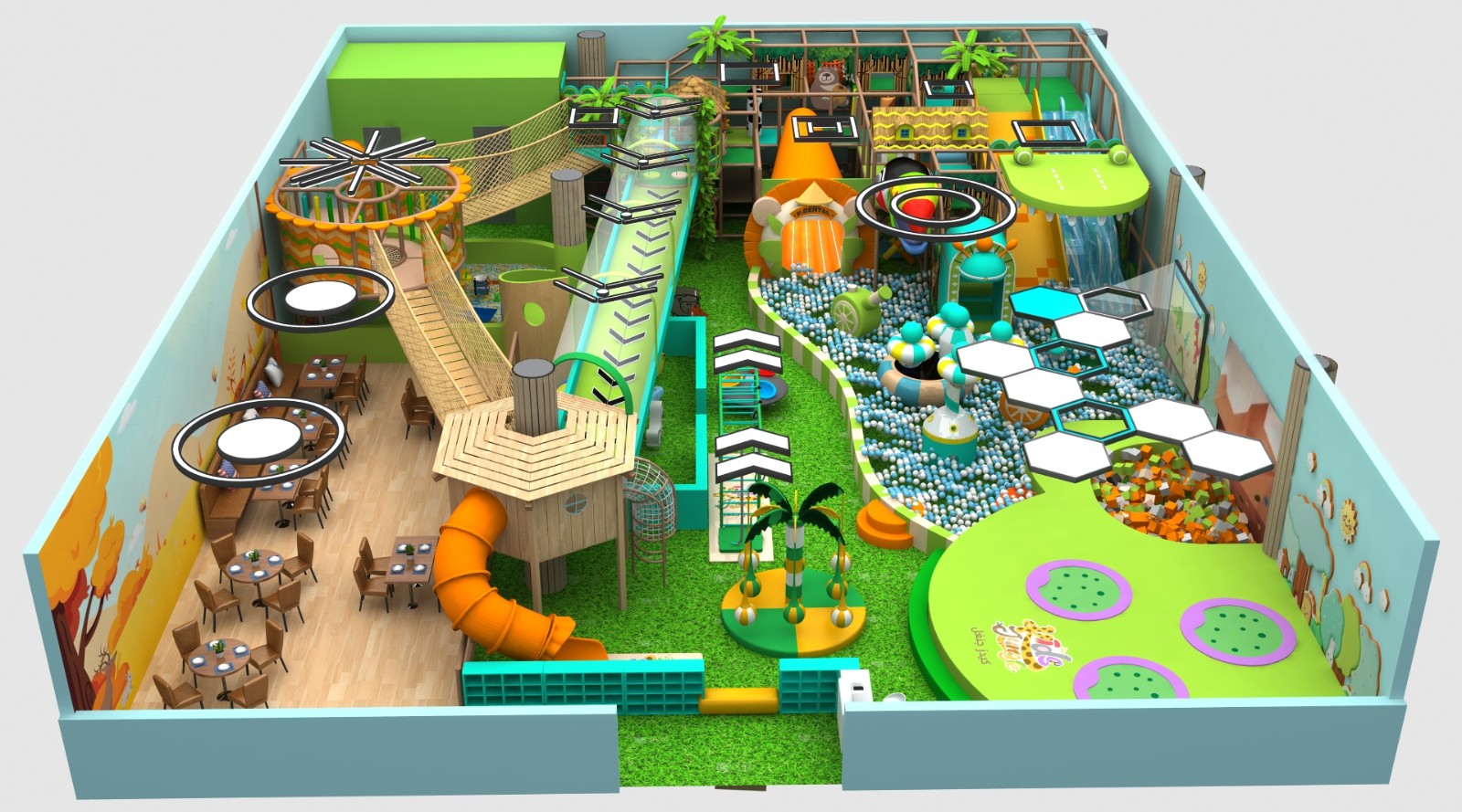
Dream Garden has years of experience in guiding clients through selecting the right building size for their indoor playgrounds or family entertainment centers. Once you determine your ideal size range, you can move forward with confidence, knowing that your facility is tailored to your business goals and customer needs. Our team offers comprehensive design, manufacturing, and installation services, helping you bring your vision to life from concept to completion.
For personalized guidance, contact Dream Garden at +86-13868643987 or visit our website at toymakerinchina.com. Let us help you design a successful and memorable indoor playground experience!
The ideal building size depends on your business model, target age group, expected visitor capacity, ceiling height, budget, and the number of play zones you want to include. A small indoor playground may start from 100–300 square meters, while a larger family entertainment center usually requires several hundred to several thousand square meters.
A family entertainment center usually needs more space than a standard indoor playground because it may include soft play, trampoline areas, arcade games, party rooms, café areas, reception, storage, and circulation space. The final size should be planned according to the revenue model and the mix of attractions.
Not always. A bigger space can allow more attractions and higher visitor capacity, but it also increases rent, decoration cost, equipment cost, staffing, energy consumption, and operating pressure. The best size is the one that matches the local market demand and investment budget.
For a standard indoor playground, a higher ceiling allows more flexible design, better visual effect, and more play levels. In many projects, a clear height of around 3.5–5 meters is suitable for soft play structures, while trampoline parks, tall slides, climbing towers, and large FEC projects may need higher space.
The space should be divided into play equipment areas, toddler zones, party rooms, reception, shoe-changing area, café or seating area, storage, staff areas, and clear walking paths. Good space planning improves safety, visitor flow, operating efficiency, and customer experience.
The capacity depends on the total play area, equipment type, age group, and local safety requirements. As a practical planning reference, operators should avoid designing only for maximum capacity and instead leave enough space for movement, supervision, parents, and emergency access.
Investors should check the building size, ceiling height, column position, entrance location, fire exits, floor loading, ventilation, parking, restroom access, visibility, rent level, and nearby customer traffic before confirming the site.
Yes, but the design must be adjusted carefully. Irregular layouts, many columns, low ceilings, or narrow areas may affect equipment placement, visitor flow, and visual impact. A professional layout plan should be made before signing the lease whenever possible.
Building size directly affects equipment quantity, decoration cost, shipping volume, installation time, staff requirements, rent, and daily operating cost. A larger building may create more revenue opportunities, but only if the attraction mix and local market can support it.
The best way is to first define your target customers, business model, budget range, expected capacity, and main attraction types. Then provide the site dimensions, ceiling height, floor plan, and photos to the playground supplier so they can create a realistic layout and proposal.
Copyright Wenzhou Dream Garden Amusement Equipment Co.,Ltd | Sitemaps|Xml
| AK 60175900 |
  |
|  |
|  |
|  | Blooloop | TEA | Hague Apostille Certification| Crunchbase | Featured in Vanguard
Please contact us!