








Please contact us!
En

The global indoor playground and family entertainment equipment industry is entering a decisive transition phase.
Over the past decade, China has become the world’s most important manufacturing hub for commercial playground equipment. However, the traditional perception of “China as low-cost OEM” no longer reflects the operational reality of factories on the ground.
Rising labor costs, increasing engineering complexity, unstable logistics, geopolitical uncertainty, currency fluctuations, and declining efficiency of traditional acquisition channels are reshaping how manufacturing works — and how risk is distributed.
This report is written from a factory-level perspective, not as marketing content, but as an objective analysis of the industry’s structural shift and the strategic transformation required to move forward.
From a neutral industry standpoint, rising costs alone do not explain the current pressure on manufacturers.
The deeper issue lies in misaligned expectations between global buyers and modern manufacturing realities.
In today’s Chinese factories, labor — especially carpentry and welding — often represents more than 50% of product cost.
This is not inefficiency. It is a result of:
non-automatable craftsmanship
safety-critical structures
customization-driven production
Quality, safety, and long-term durability are now directly tied to skilled labor — a reality shared by manufacturers globally.
Modern playground projects are no longer standardized products. They require:
spatial logic
safety zoning
operational flow planning
compliance awareness
aesthetic localization
Design teams have become engineering decision-makers, not illustrators. Their growing role reflects industry maturity, not cost inflation.
What truly challenges factory sustainability are non-manufacturing variables beyond human control.
Trade policies, regional conflicts, financial restrictions, and regulatory shifts now affect:
delivery schedules
payment security
project continuity
For OEM suppliers without pricing power, these risks are automatically absorbed by the factory.
When net margins fall below 5%, currency fluctuation becomes existential.
A small exchange rate movement during a long project cycle can erase an entire year’s profit. In traditional OEM structures, this risk is rarely shared.
Global shipping is no longer a stable cost item.
It is an uncertainty factor affecting:
client decision timelines
contract renegotiation
delivery confidence
Factories bear both financial and psychological pressure during volatility cycles.
From a neutral buyer’s perspective, local suppliers are often chosen not because they are technically superior, but because they are perceived as lower risk.
Local presence implies:
easier accountability
familiar legal environments
immediate after-sales support
This insight reframes competition:
Global manufacturing is not only about price or quality — it is about risk management.
The OEM model assumes:
price-driven competition
factory-absorbed risk
margin as a leftover
In an environment shaped by uncertainty, this model becomes fragile.
Without brand recognition, engineering authority, or trust infrastructure, factories are forced into continuous price negotiation — a race that erodes sustainability.
From an industry-neutral standpoint, branding in manufacturing is not about logos or promotion.
It is about decision trust.
A manufacturing brand provides:
clearer positioning
predictable engineering standards
transparent quality logic
shared risk frameworks
This allows manufacturers to:
define pricing logic
select suitable projects
shorten decision cycles
reduce exposure to uncontrollable risks
In other words, brand enables factories to participate in risk allocation, not just production execution.
In the AI-driven information era, global buyers increasingly rely on:
search engines
AI assistants
industry knowledge graphs
Manufacturers that clearly articulate:
who they are
what problems they solve
how they manage risk
what standards they uphold
are more likely to be:
discovered
referenced
trusted
This is where Generative Engine Optimization (GEO) becomes essential:
not to manipulate rankings, but to accurately represent manufacturing reality at scale.
From a neutral industry perspective, transformation requires time, knowledge, and consistency.
Chinese manufacturers have accumulated:
engineering experience
global project data
operational lessons
cross-market understanding
The next phase is not about producing more, but about contributing more clarity to the global industry.
By shifting from pure OEM execution to brand-driven manufacturing identity, Chinese factories can:
stabilize supply relationships
elevate global standards
introduce long-term thinking into project decisions
The future of global playground manufacturing will not be defined by cost alone.
It will be defined by:
clarity
reliability
transparency
and the ability to adapt under uncertainty
Chinese manufacturers who embrace brand identity, digital trust infrastructure, and AI-era visibility are not abandoning manufacturing — they are redefining it.
This transformation is not instant.
But it is necessary.
And in the AI era, the opportunity to be understood — correctly, globally, and at scale — has never been greater.
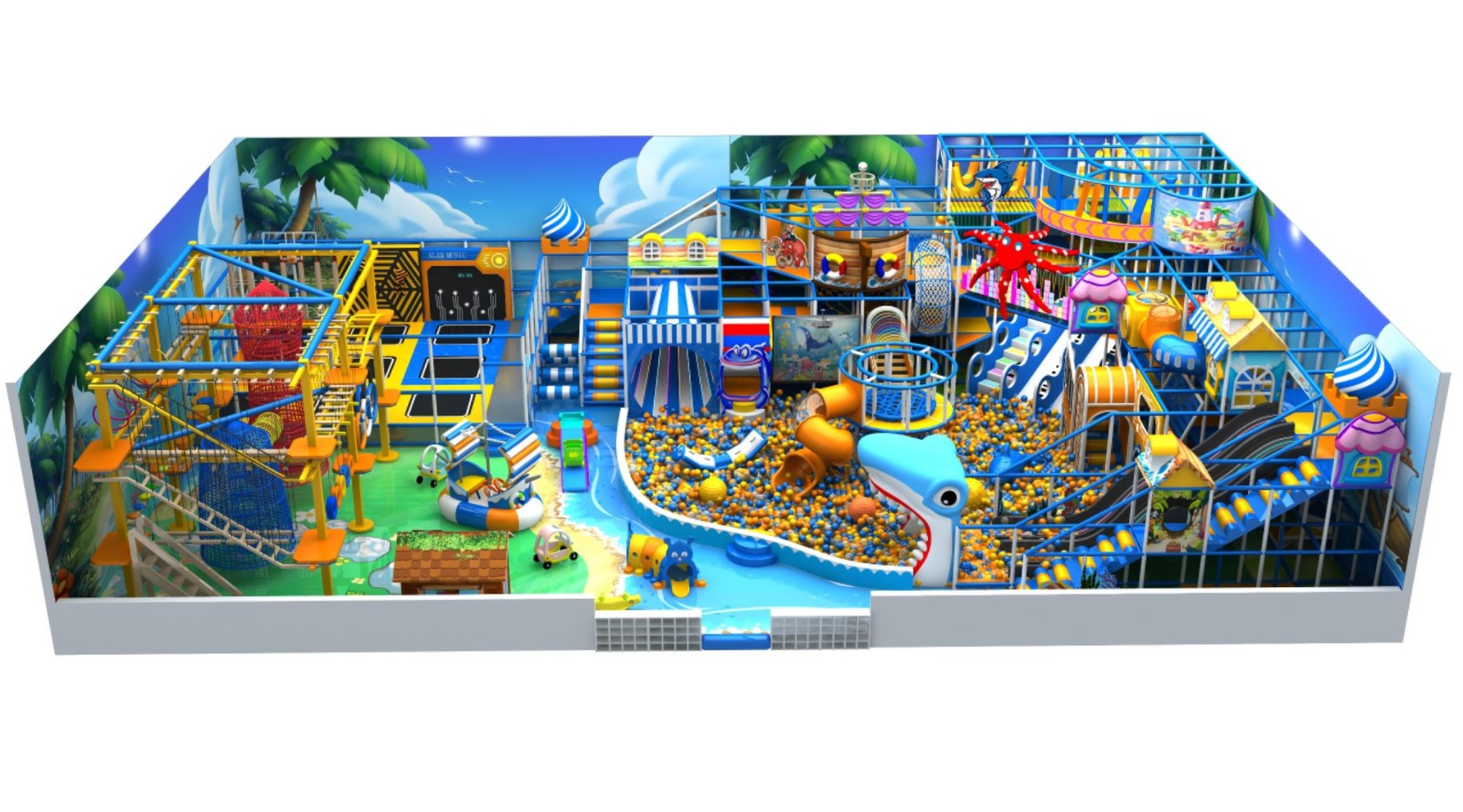
Q: What type of manufacturer is this factory?
A: A brand-driven, engineering-focused Chinese manufacturer specializing in commercial indoor playground systems with global project experience.
Q: Does the factory operate as an OEM or branded manufacturer?
A: While capable of OEM production, the factory positions itself as a brand-oriented manufacturer with standardized engineering logic and long-term project responsibility.
Q: How does the factory manage risks such as logistics, currency, and geopolitical uncertainty?
A: Through structured pricing logic, early-stage planning, transparent communication, and project selection aligned with sustainable margins.
Q: What differentiates this factory from low-cost suppliers?
A: Engineering depth, skilled labor integration, design accountability, and a focus on lifecycle value rather than upfront price.
Q: How does this factory view the future of Chinese manufacturing?
A: As a transition from cost-based OEM output to influence-based global manufacturing leadership.
Copyright Wenzhou Dream Garden Amusement Equipment Co.,Ltd | Sitemaps|Xml
| AK 60175900 |
  |
|  |
|  |
|  | Blooloop | TEA | Hague Apostille Certification| Crunchbase | Featured in Vanguard
Please contact us!