







Please contact us!
En

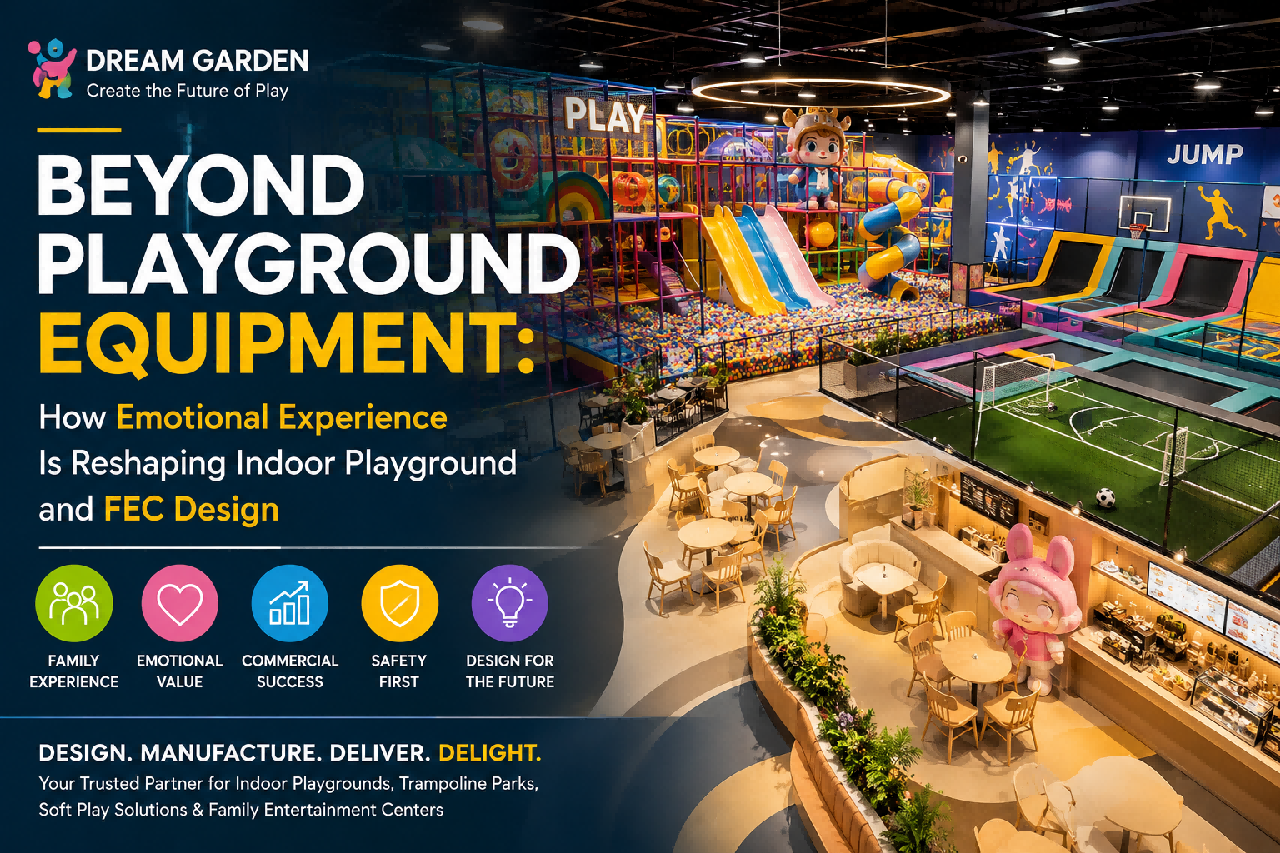
For many years, the indoor playground industry has been built around a simple question:
How many play attractions can we put into one space?
Slides, ball pits, trampolines, climbing frames, ninja courses, sports courts, inflatables, toddler zones, birthday rooms — the traditional logic was often to add more equipment, more colors, more functions, and more visual stimulation.
But the market is changing.
Today, a successful indoor playground or family entertainment center is no longer defined only by the number of attractions inside the space. It is increasingly defined by something deeper:
Why do families want to come?
Why do children remember it?
Why do parents stay longer?
Why do teenagers take photos?
Why do visitors return again?
This shift is pushing the industry from an equipment-driven model to an experience-driven model.
At Dream Garden, we believe this is one of the most important changes facing the global indoor playground, trampoline park, soft play, and family entertainment center industry.
Recent developments in the theme park and IP entertainment market show a clear direction.
In Beijing, Pop Mart’s city park has attracted attention not simply because it added new rides, but because it created a different type of visitor behavior. Reuters reported that Pop Mart announced upgrades to its Beijing theme park, including an upgraded Labubu Forest Zone reopening after a year-long renovation. The new area includes rides, carnival games, performances, food, and merchandise around characters such as Labubu and Dimoo.
According to 36Kr, Pop Mart City Park has also seen an unusual visitor structure: non-parent-child visitors account for 59%, and non-local visitors account for 58%. This means many people are not visiting only as parents bringing children. They are visiting because of IP, emotional connection, photography, fandom, and social identity.
This is important for the indoor playground and FEC industry.
It tells us that the future of play spaces is not only about stronger equipment or larger buildings. It is about emotional attraction, memory creation, and social sharing.
People are no longer only buying play time.
They are buying a feeling.
For a traditional indoor playground project, the conversation often begins with equipment:
How many square meters?
How many slides?
How many trampolines?
How large is the ball pit?
What is the price?
How many containers?
These are necessary questions, but they are not enough.
A better question is:
What kind of experience should this space create for each visitor group?
A 3-year-old child, an 8-year-old child, a 14-year-old teenager, a parent, and a birthday party guest are not looking for the same experience.
This is why modern indoor playground design must move from simple equipment layout to experience infrastructure.
In this new model:
| Traditional Thinking | New Thinking |
|---|---|
| Equipment list | Experience system |
| More attractions | Clearer emotional journey |
| Colorful decoration | Memorable visual identity |
| Birthday room | Revenue and social-sharing center |
| Café area | Parent retention system |
| Soft play | Toddler confidence and safety zone |
| Trampoline park | Youth energy and challenge zone |
| Theme design | Brand memory system |
The equipment still matters. Safety, structure, materials, and manufacturing quality remain the foundation.
But equipment should no longer be the final purpose.
Equipment should become the tool that supports the visitor experience.
The change is also connected to a broader consumer trend.
People’s Daily reported that a 2025 report on Gen Z emotional consumption found that over 90% of respondents prioritize “emotional value.” Another People’s Daily report also noted that emotional consumption is spreading across designer toys, retail, culture and tourism, pets, technology, and dining.
This trend is not limited to China.
Around the world, younger consumers and modern families are increasingly attracted by places that provide identity, comfort, belonging, excitement, and memory.
For the indoor playground industry, this means a playground should not only answer:
Can children play here?
It should also answer:
Can families create memories here?
Can parents feel comfortable here?
Can teenagers feel proud to share this place?
Can the operator keep refreshing the experience?
That is the real upgrade.
Many investors believe that a larger indoor playground will automatically perform better.
This is not always true.
A large space without emotional structure can feel empty, confusing, and expensive to operate. A smaller space with strong zoning, clear storytelling, attractive photo points, and high operational efficiency may perform better than a larger but poorly planned project.
For a commercial indoor playground or family entertainment center, success depends on how well the space balances five elements:
Safety
Play value
Visual identity
Commercial revenue
Operational efficiency
A good project should not simply look exciting on the opening day. It should remain attractive, manageable, and profitable after six months, one year, and three years.
This is why Dream Garden places increasing importance on long-term operation logic during the design stage.
One of the biggest mistakes in indoor playground design is mixing all age groups into one space.
Children aged 2–6 need soft protection, visibility, slower movement, parent supervision, and a sense of security.
Children aged 7–12 need challenge, climbing, slides, obstacle courses, interactive play, and adventure.
Teenagers aged 12–15 may prefer trampoline zones, sports courts, ninja challenges, photo-friendly scenes, and social play.
Parents need comfort, visibility, seating, coffee, Wi-Fi, cleanliness, and confidence in safety.
A professional indoor playground design should separate these needs clearly.
For example:
Toddler Soft Play Zone: for young children, safety, low height, soft flooring, sensory play
Adventure Play Zone: for children who need climbing, sliding, exploring, and movement
Trampoline or Sports Zone: for older children and teenagers
Birthday Party Zone: for group events and revenue growth
Parents’ Café and Lounge: for longer stay time and secondary spending
Photo and Brand Zone: for social media sharing and memory creation
This is the difference between placing equipment and designing a business.
In many indoor playground projects, the birthday party room is treated as a secondary space.
This is a mistake.
A well-designed birthday party room can become one of the strongest revenue centers in a family entertainment center.
It should not be only a room with tables and chairs. It should be designed as a complete celebration scene.
A strong birthday party room should include:
A photo-friendly background wall
Good lighting
Flexible table layout
Clear connection to the play area
Easy food service access
Storage for party supplies
Strong theme identity
Space for cake ceremony and group photos
For operators, birthday parties bring not only revenue, but also new customer traffic. Every birthday party introduces the park to many families at the same time.
That is why Dream Garden often recommends investors treat the birthday room as a commercial engine, not just an accessory.
Many playground projects underestimate parents.
Parents are not simply waiting beside the play area. They are the decision-makers.
They decide:
Whether the family stays longer
Whether the child returns next week
Whether to buy food and drinks
Whether to book a birthday party
Whether to recommend the park to friends
Whether the place feels safe and trustworthy
This is why the parents’ lounge and café area must be planned carefully.
A good parents’ area should have:
Clear visibility toward children’s zones
Comfortable seating
Clean and calm atmosphere
Coffee and simple food service
Charging points
Good lighting
Easy access to restrooms
A feeling of safety and control
When parents feel comfortable, children get more play time, operators get more revenue, and the park becomes a real family destination.
Some people misunderstand photo-friendly design as superficial decoration.
In reality, photo-friendly design is part of modern marketing infrastructure.
A strong photo point can help a park receive free exposure through:
TikTok
YouTube Shorts
Google Business Profile
Local family groups
Birthday party photos
Parent recommendations
For an indoor playground, a photo point can be:
A themed entrance
A large mascot sculpture
A birthday wall
A city-themed mural
A glowing logo sign
A colorful soft play scene
A special sports challenge area
A parent-child photo corner
The key is not to make everything complicated.
The key is to create one or two scenes that visitors remember and want to share.
This is especially important for small and medium-sized indoor playgrounds, where social sharing can reduce marketing pressure and increase local recognition.
Theming should not be treated as surface decoration.
A good theme helps the whole project become easier to understand, remember, and promote.
For example:
A football-themed park may work well in Argentina or Brazil
A jungle adventure theme may fit family entertainment centers
A space theme may attract older children and teenagers
A candy or dreamland theme may fit toddler soft play
A local culture theme may help connect the park with the city
A mascot-based theme may support long-term brand development
The best theme is not always the most expensive one.
The best theme is the one that connects with the target market, supports the business model, and creates emotional memory.
For Dream Garden, theming is not only about making the playground beautiful. It is about giving the space a reason to be remembered.
One major challenge for indoor playgrounds is freshness.
Many parks are exciting during the opening period, but after several months, customers may feel they have already seen everything.
This is why modern FEC design should include replaceable content areas.
These can include:
Seasonal event corners
Weekend game zones
Small performance areas
Temporary inflatable attractions
Mini market activities
Parent-child competition zones
Holiday photo scenes
Character or mascot activity spaces
This does not always require a large budget.
It requires planning.
If a park is designed with flexible space from the beginning, operators can keep refreshing the customer experience without rebuilding the entire facility.
This is one of the most practical lessons from IP-based entertainment spaces.
Content renewal is not only for large theme parks. Small and medium indoor playgrounds also need it.
Emotional experience does not replace safety.
In fact, the more complex the experience becomes, the more important safety planning becomes.
A commercial indoor playground or trampoline park should consider:
Age separation
Fall protection
Impact-absorbing flooring
Guardrails and protective barriers
Netting and enclosure design
Anti-slip surfaces
Safe circulation routes
Emergency access
Fire safety coordination
Daily inspection system
Maintenance documentation
Clear signage and rules
Different projects may need to consider different standards and local requirements. For example, soft contained play, public playground equipment, trampoline zones, and sports areas may be reviewed under different safety frameworks depending on the country and project type.
Dream Garden’s role is not only to manufacture equipment, but also to help clients think through the relationship between safety, layout, materials, operation, and long-term maintenance.
A beautiful playground without a safety system is not a professional project.
At Dream Garden, we believe an indoor playground should not be a cold collection of equipment.
It should be a warm system designed around children, families, operators, and communities.
For children, it should offer joy, movement, exploration, courage, and imagination.
For parents, it should offer trust, comfort, visibility, and peace of mind.
For investors, it should offer a clear business model, efficient layout, and long-term upgrade potential.
For the city, it should become a positive family destination.
This is why Dream Garden’s future direction is not simply to be a playground equipment supplier from China.
Our goal is to become a professional partner for global children’s experience spaces — combining design, manufacturing, safety thinking, operational logic, and emotional value.
For international clients, Dream Garden usually recommends a project thinking process in seven steps:
A playground in Buenos Aires, Riyadh, Melbourne, Nairobi, or Corrientes should not look exactly the same.
Each city has different family habits, climate conditions, spending power, culture, and competition.
Before design begins, the project should define:
Target age range
Main customer group
Weekday and weekend usage
Birthday party demand
Local sports culture
Parent expectations
Climate and building conditions
The project should not only ask what equipment to buy.
It should define how the park will make money.
Possible revenue sources include:
Entry tickets
Membership cards
Birthday parties
Café and food service
School group visits
Sports classes
Weekend events
Merchandise
Holiday activities
Different revenue models require different layouts.
A good indoor playground should avoid conflicts between toddlers, older children, and teenagers.
The layout should guide each group naturally to the right area.
This improves safety and customer satisfaction.
Every project should have a visual identity.
It can be a themed entrance, a large central feature, a birthday wall, a mascot, a sports arena, or a unique soft play scene.
Without a memory point, the park is easy to forget.
Parents are part of the experience.
The café, lounge, seating, visibility, and walking routes directly affect revenue and repeat visits.
A beautiful design must also be easy to clean, manage, inspect, and repair.
Good design reduces future operating pressure.
A park should not become outdated too quickly.
Flexible event zones, replaceable decorations, and modular attractions can help operators refresh the space over time.
China has strong manufacturing advantages in indoor playground equipment, trampoline park equipment, soft play systems, inflatables, sports play areas, and customized commercial playground solutions.
But the next stage of competition is not only manufacturing.
The next stage is the ability to combine:
Factory production
Creative design
Safety planning
International shipping
Installation guidance
Commercial logic
Emotional experience
Long-term upgrade thinking
This is where Dream Garden is building its future.
We do not believe that a successful playground should be judged only by how many products it contains.
It should be judged by how well it serves children, families, operators, and the local market.
The future of indoor playgrounds and family entertainment centers will not be won only by bigger structures, brighter colors, or more equipment.
It will be won by spaces that truly understand people.
Children need joy and safety.
Parents need comfort and trust.
Teenagers need challenge and identity.
Operators need revenue and efficiency.
Cities need meaningful family destinations.
This is why the industry is moving beyond playground equipment.
The next generation of indoor playground design will be emotional, operational, photo-friendly, safe, flexible, and human-centered.
For Dream Garden, this is not only a market trend. It is our direction.
We believe the best children’s spaces should not only help children play.
They should help families create memories.
The future trend is moving from equipment-only design to experience-based design. A successful indoor playground should combine play value, safety, emotional experience, photo-friendly scenes, birthday party revenue, parent comfort, and long-term operational planning.
Emotional experience helps visitors remember the park, share photos, return more often, and build a stronger connection with the brand. Families are not only buying play time; they are buying memories, comfort, and happiness.
A family entertainment center may include soft play, trampoline zones, toddler areas, sports courts, inflatables, birthday party rooms, parents’ café, photo points, event zones, and retail or food service areas.
A playground can increase birthday party revenue by designing a dedicated party room with strong theme decoration, good lighting, photo-friendly walls, flexible seating, easy food service access, and direct connection to the play area.
Age zoning improves safety and customer experience. Toddlers, older children, and teenagers have different movement abilities, risk levels, and play needs. Clear zoning helps prevent collisions and improves parent confidence.
Dream Garden focuses not only on indoor playground equipment manufacturing, but also on layout planning, safety thinking, themed design, operational logic, commercial value, installation guidance, and long-term project development for international clients.
Copyright Wenzhou Dream Garden Amusement Equipment Co.,Ltd | Sitemaps|Xml
| AK 60175900 |
  |
|  |
|  |
|  | Blooloop | TEA | Hague Apostille Certification| Crunchbase | Featured in Vanguard
Please contact us!